The Reason I’m Staying Home

It can be argued that the purpose of entertainment, any entertainment, is escapism. Immersion in a preferred diversion allows us to indulge ourselves in ways that aren’t doable in everyday life. The flavors to choose from are almost limitless: the arts, sports, gaming, movies, YouTube…and of course, books. I read to challenge myself, I read to learn something new, I read to figure shit out —but I also read to slide into a little old-fashioned popcorn escapism. And when it comes to escapism, nothing beats a deep delve into places I don’t want to go. The best way for me to get out of town is curling up with a book and getting down with some armchair travel.

I LOVE armchair travel. I don’t have to pack anything, I can have snacks anytime I want, and most importantly, I don’t have to pack anything. It’s not that I don’t love going places. I really do. I just hate packing. When choosing an armchair travel book, I’m not fooling around. I don’t want some gentle, humorous vacation anecdote. Think thickly forested tropical jungles, rivers that traverse entire continents, or monsoon-drenched mountain topography. Throw in a full narrative involves a journey from one end of a country to another and I’m helpless to resist. As long as I’m not going somewhere, I want to not go to as much of it as possible.

Armchair travel also gets me off the hook for pretending to embrace new, unnerving experiences. Bluntly put, I am a big fat coward. In real life, I do not enjoy situations that intimidate and/or terrify me, but I bulldoze my way through my discomfort when I have to. But in my entertainment? Why I gotta suck it up? There are some non-negotiable scary things that I’m just not invested enough fake my way through. Take horror movies, for instance. My system can’t take looking at all that spurting blood and what’s the payoff? If I make it through Saw, I can do the whole awful experience again with Saw II? SRSLY. Hard pass. Accordingly, my armchair travel often centers on locations where I’m never going to go in person because it’s TOO SCARY. Specifically, I am always going to avoid any place on the globe where one can find the Giant Restless Spider Populations. If a given locale has spiders the size of frisbees, I can’t. I. CAN. NOT. (This is not meant to disparage spiders or the spider-loving humans among us. You’re all lovely and amazing and can you just stay on that other side of the room please? Or maybe outside? Yes. Outside is better.) But I definitely have enough gumption to read about spider-infested places, because I am a profile in courage.

Whether you prefer your arachnid-infested vacations fictional or non-fictional, I’ve got you covered. These books also have jungles, treasure, world history, and tigers. Grab your can of Raid and let’s jump in.

The Strangler Vineby M.J. Carter, is an Edgar-nominated novel set in 1837 India, at the height of British colonialism and the dawn of the Victorian era. When it came to establishing British rule in invaded nations the British government was dependent on the influential and powerful British East India Company.  Chartered in 1600 to pursue and protect trade routes for Britain, the British East India Company was a strange hybrid of army, for-profit corporation, and unchecked police force that leveraged the veneer of the British government without any accountability to any checks or balances. The odd structure of the company – private ownership that rested in Britain’s ruling peer class acting to create wealth for the nation – was a conflict of interest nightmare that spawned opportunities for abuse and corruption, with the populations of the countries that East India looked to dominate paying the price.  Where was the morality in disregarding the culture and existing governments of invaded countries? What dictates how we choose our loyalties? The Strangler Vine lays out these questions as a brilliant structure for a good old-fashioned road adventure and mystery thriller. Newly arrived in India, rookie East India officer William Avery is reluctantly paired with disgraced Company veteran Jeremiah Blake and tasked with finding the missing Xavier Mountstuart, a lauded poet whose latest work has caused a scandal within the British community in Calcutta. The East India Company wants Mountstuart found so they can safely send him back to Scotland and settle the scandal…or do they? The motives and means surrounding Mountstuart’s recovery provide the thriller backbone to this story, and you will root for Avery and Blake’s unlikely friendship. I love a plot that is predicated on ‘capture the threatening poet’. It’s a fast-paced, quixotic book, and it contains the best chase scene I’ve ever read. It also has a man-eating tiger. It probably had a bunch of India Jungle Spiders too but I closed my eyes during all those parts.

The Lost City of Z by David Grann, is a non-fiction account of Victorian-era British explorer Percy Fawcett’s obsessive search for the legendary, lost city of El Dorado in Brazil’s Amazon. The same British Empire colonialist philosophy that created the East India Company also fostered a generation of British explorers, men who crisscrossed the world and brought proof of their travels back home to Mother England. Some explorers were motivated by science, to find and classify new species of flora, fauna, and animal. Some were motivated by competition, to be the first to climb mountains or cross the Arctic Circle. And some were motivated by acquisition, seeking caches of gold and treasure. It was this last category that Percy Fawcett falls. After years of expeditions in Bolivia, Brazil, and Peru, Fawcett was convinced that the Amazon hid the ruins of El Dorado, an ancient city thought to be only a myth. Sure that he had determined its location, Fawcett led a search party that included his son into the jungle in 1925. The group disappeared. David Grann’s description of turn-of-the-century South American travel and his own foray into the Amazon are almost suffocatingly accurate. Well, I assume the description is accurate. It sure felt accurate, as I checked every room I entered for giant Brazilian monkey spiders for days after I finished the book. For all its classic adventure narrative, The Lost City Of Z’s examination of Fawcett’s single-mindedness and the larger implications of the relationship between the Old World and the New World is incredibly compelling.

suitcase

All packed!

Have a lovely time, keep your windows rolled up, and call me when you get there! In the meantime, I am going to go not unpack. I’m exhausted.

#checkforspiders

Action Items
The Lost City of Z was developed as a film and is being released this year. Robert Pattinson is in it and I was surprised because I was unaware of recent vampire activity in Brazil. Anyway, watch the trailer here.
The Reason For Cold Turkey

Hello, January! That magic time of year when weeks of unbridled decadence skid to a halt puddling into a big pile of regret and shame. It is time for a reckoning. (Doesn’t it feel like the holiday excuse period starts earlier and earlier? Using Labor Day as a free pass for excess is weaksauce. Nobody is buying “What the hell, it’s Labor Day!” as a valid reason to have cheese dip for breakfast. You do you. Just have the cheese dip. Why you gotta blame Labor Day?) January is the month when it’s time to rein in all those shenanigans and act like an adult, for Pete’s sake. Shed those extra pounds from all that gravy and chocolate. Return those superfluous gifts you overbought. In my case, January detox also commences the annual Big Cleanup, purging a year’s worth of crap that’s turned every surface of my living space into a junk drawer.

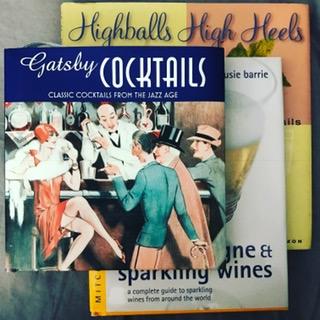
It was in the process of shoveling out one of those squirrel-nest piles that I found three fancy little books of cocktail recipes that I completely forgot that I owned. I probably had big intentions of featuring the books in some Pinterest-worthy, artfully arranged bar display with fancy empty antique bottles and brass corkscrews. I got really close to doing it, too, in that I bought these three books and shoved them in a drawer four years ago. Take THAT, Pinterest. Flipping through the books, I got to thinking about the tight relationship between writing and booze. Lots of authors like to bring the party to the page. Literature featuring booze is like a big liquor store: from cheap peach schnapps to pricey Scotch that smells like old socks, there is something for everyone. Here are some that made an impression on me.

The Great Gatsby (F. Scott Fitzgerald) The Great Gatsby is the book that really showed America how to get lit. Main character Jay Gatsby, putting out bait to attract his former love and current neighbor rich girl Daisy Buchanan, turns his exclusive West Egg, Long Island estate into neighborhood central for a 24/7 throwdown. His party only has two rules: Look fabulous and make bad choices. In the words of F. Scott Fitzgerald, “everybody in the club getting tipsy.”* Fitzgerald knew a thing or two about parties, having codified uninhibited and licentious behavior in his collection of short stories, Tales Of The Jazz Age. For all of his literary success, Fitzgerald never felt a part of the elite American wealthy society that he made so famous. That bittersweet longing for inclusion is brilliantly expressed in the book’s narrator Nick Carraway’s attendance at Gatsby’s endless, gin-soaked party. Nick is there, he’s an invited guest, he is welcomed by his host, and yet he can’t shake the feeling that he’s still on the outside looking in. As if with his nose pressed against the glass, peering in the window, Nick walks us through the kind of inevitable debauchery that results when a party is underwritten by organized crime and sponsored by a lovesick pretender.

*Possibly J-Kwon**
**Definitely J-Kwon

Tequila Mockingbird: Cocktails With A Literary Twist (Tim Federle) This book of cocktail concoctions proves there is a niche audience at the intersection of English Major Ave and Fully Stocked Bar St. I always thought I was the only person who lived at that address but LOOK. I HAVE ROOMMATES. Page after page of beverages, all inspired by and named for classic works of literature? SQUEEEEEE. Eventually, I’ll get around to making one of the many outstanding drinks in this book, but for now, it’s not necessary because I’m just drunk on all the literary references and stellar puns. As a bonus, this book’s list of classic titles fleshed out my TBR list. (How could I have forgotten I haven’t read The Unbearable Lightness of Being?) One day, I am going to meet author Tim Federle and make him several Pitchers of Dorian Grey Gooses. (Geese? Pitchers of Dorian Grey Geese? I need to work this out before Tim gets here….or just avoid the whole question and make him a batch of Woman In White Russians.)

Postcards From The Edge (Carrie Fisher) The main character in Carrie Fisher’s debut novel is an equal-opportunity substance abuser, so we’re not limited to alcohol here. This semi-autobiographical story of a working actress with a famous mother coping with her day-to-day life LA after rehab pulls no punches as it chronicles the reality of living the glamorous life in the world’s biggest fishbowl. It’s hilarious, heartbreaking, and above all brutally honest. Carrie Fisher is unique in her ability to take cringeworthy, painful situations and craft side-splitting comedy while never succumbing to self-pity. It gives her work an emotional integrity that resonates long after you’ve stopped laughing.

“The Swimmer” (John Cheever) For every cheerful depiction of the convivial camaraderie of drinking, there is someone living the toxic nightmare of addiction. John Cheever captures the dark, chaotic recklessness of chronic alcoholism in his startling short story, “The Swimmer”. Surreal and hypnotic, the story depicts the slow collapse of a life dragged under by habitual benders and the hazy confusion brought on by too many booze-induced blackouts. Cheever knew a thing or two about drinking to excess. His lifelong struggle with alcoholism was a family affair, with his father and his brother both sufferers, and Cheever almost died from an alcohol-induced embolism before he was able to quit drinking for good. In “The Swimmer”, Cheever depicts the pain and vulnerability at the core of self-destructive behavior while avoiding showing any sympathy for the damage that it does. It’s poignant, enlightening, and a little scary.

Honorable Mention: The Secret History (Donna Tartt) Get drunk with your friends! Pretend you’re a deer! Maybe kill some people! HAHAHHAHAHAHA parties are fun!


cocktails

Clutter.

#cheers

Action Item
For more silly words about The Secret History, click here. And, for the record, I will happily make Pitchers Of Dorian Grey Gooses/Geese for Donna Tartt any time she wants.

The Reason I’m Reacting

I am surfacing for air after an intense binge reading week. Like, a don’t-talk-to-people-have-food-delivered-take-your-book-with-you-everywhere week. You know: maniacal. I think that I may have been reacting to the dream I had in which I had a visit from Thornton Wilder. (If you’re curious about that little nugget, catch up here.) I’ve been wondering what Thornton might be trying to convey. Why me? As an actual writer, is he personally offended by my amateur-hour book blog? Is he curious about how to set up his own WordPress account? Does he think my book choices are not challenging enough? Is he making fun of me behind my back to all the other ghost Pulitzer prize authors at the ghost Pulitzer prize cocktail parties?

In short, I read a lot this week because I am worried about being judged by an award-winning figment of my imagination. Let’s see how that played out at the bookstore!

The Haunting of Hill House (Shirley Jackson) Make no mistake-Shirley Jackson is here to play with your head. She knows how to scare you and she is going to scare you, so put your feet up and enjoy the ride. If you’ve read any Shirley Jackson, it’s probably her short story, “The Lottery”, because it has ascended to Required Reading status. It’s there for a reason: “The Lottery” is so scary it will hide behind your closet door just so it can scream “BOO” when you go to change your shoes. Jackson’s novel The Haunting of Hill House is a ghost story, a gothic horror novel, and a master class in subtle atmospheric manipulation. SHIRLEY JACKSON WANTS YOU NERVOUS. Using the standard horror premise, “let’s all spend the night in a haunted house and see if it’s really haunted”, Jackson uses distorted perceptions and exploits character flaws to make every word suspenseful. The wall between reality and imagination becomes thinner and thinner. What keeps us civilized? What keeps us human? How easily are we broken?
PS: Safety tip for you: Just assume the house is haunted without sleeping in it. Why am I even having to tell you this?

The Last Days Of Night (Graham Moore) Widespread use of harnessed electricity is a technological innovation that is barely 100 years old, but it is ubiquitous to the point of invisibility. Really: how often do you think about electricity? The only time I think about electricity is when I can’t find a place to charge my phone, and I need my phone charged because those candies aren’t going to crush themselves, people.  The Last Days Of Night tells the origin story of all those blazing lights and Teslas that now populate daily life. The right to capitalize on the commercial adaptation of electricity for household use was an out-and-out legal brawl between Thomas Edison and George Westinghouse. The interplay between the inventors, the engineers, the businessmen, and the lawyers is fascinating. Nobody played fair, and nobody played nice. There’s no crying in the engineering lab. Graham Moore has looked at all those inscrutable historical documents and extracted a lively, incredible story that sparks and crackles. (GET IT)

Arcadia (Lauren Groff) Lauren Groff’s 2015 novel, Fates and Furies, is an amazingbeautifulheartrendingmasterful book that I am still not over. (Feel free to indulge my fangirling about that book here.) Arcadia, published in 2012, is a story about the lifespan of a commune in upstate New York. From the 1970s and into the future, Groff traces the fervent idealism that gives way to the reality of the daily grind that gives way to the abandoning of the effort through the eyes of Bit. Born into the commune community, Bit grows up ranging the fields and woods of Arcadia, the commune co-founded by his parents with their charismatic friend Handy. Handy is more interested in glory and attention than in the reality of governing the commune. Working with his parents to keep their utopia afloat and then finding his way in the wider world as he grows up and the community that he loves so much falls apart, Bit sees himself as the keeper of the flame. He maintains the desire for purity and goodness, the motives that made Arcadia such an attractive proposition, even as it is doomed to fail. Groff looks at what inspires loyalty and dedication, what makes people stay together, and what damage can be done and undone over a lifetime. I love the way she threads Greek mythology into the book, illustrating that the ways people love each other and hurt each other aren’t new; they are just new to us.

I hope all this plays well when Thornton tells his friends. Maybe I’ll even get an invite to the next cocktail party.


cocktail-party

I’ll wear something subtle.


#bingeit

Action Items
All of these books were procured at Sundog Books in Seaside, Florida. Shop your local indie bookstore!
The Haunting of Hill House has been adapted into a movie twice, in 1963 and in 1999. (I haven’t seen them because I don’t like scary movies that scare me.)


The Reason You Like Me, You Really Like Me

Last night, I had dinner with a group of friends that I have known for a while. We get together every few weeks or so, put a bottle of wine on the table, and catch up with each other on all the things that are happening, or have happened, or might happen. We ask each other for advice. We giggle (or in my case, laugh very loudly with a noise that might make you think “Is there a donkey here? And did someone set its tail on fire? THAT IS A VERY BAD NOISE.”)and we never leave without making plans for the next time we will see each other, because we like each other, and it’s always good to have future plans to be with people you like. It makes all the days where you have to spend time with people you don’t like endurable. (Sure, it’s easier to avoid people you don’t like, but honestly, unlikable jackwagons have a way of forcing themselves into all kinds of situations.)

The connections that sustain, that provide pleasure, that ring with value, happen with people and—at least for me—with books. Connecting with a book is unpredictable. Falling in love with a book is like falling in love with a person–you caught lightning in your bottle. But what attracts the lightning in the first place? It’s easy to define what repels lightning. Dealbreakers include not sharing your french fries, not letting me eat your french fries, and not offering me any of your french fries. (Also I will need some ketchup.) There’s no way to guarantee that spark between people will turn into a friendship or that opening a book will lead to a new favorite read. There are some ways that make it more likely for a friendship to cement, and that is to start with a character who is delightful, a character who makes all your encounters interesting, a character who manages to command your attention without hogging the spotlight. Such is the Russian gentleman and citizen of the world Count Alexander Rostov in Amor Towles’s absorbing new book, A Gentleman In Moscow. THIS BOOK, Y’ALL.
You: Why is she running around in a circle flapping her hands?
Book: She’ll calm down in a minute
You: Ok but WHY
Book: She does this when she really likes a book

I want to tell you all the things about this book ALL OF THEM PLS READ IT SO WE CAN JUST TALK ABOUT IT OK but in the interest of you not pushing me out of a moving blog, I will reluctantly limit myself to some major fangirling over Count Alexander Rostov. Born into Russian royalty at the turn of the century, Count Rostov behaves as it is expected for a Russian gentleman to behave. He speaks French, he travels, he is educated and worldly, and he conducts himself impeccably in the nuanced, complicated code of a European aristocrat. Unfortunately for him, that whole skill set gets super unpopular at the onset of the Russian revolution. Like, stand-by-that-wall-and-wait-to-get-shot unpopular. Luckily for us, Count Rostov escapes a date with an itchy Bolshevik trigger finger and is instead sentenced to a lifetime of house arrest at the Hotel Metropol in sunny, balmy Moscow. The book commences as Count Rostov’s trial concludes and spools out a life spent in the same in the same location, never free to go, only free to stay. He is so good at his staying that I am looking into “House Arrest At A Hotel” retirement packages because I am SOLD. I want the deluxe version, where my room is next to Rostov’s and I get to hang out with him at the bar every night, thus fulfilling my family motto “If You Can’t Make Friends Buy Imaginary Book Ones As Part Of Your Retirement Planning.” (We have it inscribed in Latin on our family crest, which is an emu stealing food out of a car at a wildlife safari.)
You: That was a lot of words
Book: Yup
You: I’m just saying, it doesn’t seem like she limited herself there
Book: Fangirls have no limits


emu2

Family pride.


Russian history is epic, but since 1922 Russian history has attempted to cram all the epic it could possibly ingest into one big history meal. It’s an epic binge. The Revolution, Lenin, World War II, Stalin, the Cold War, the Iron Curtain—it’s a nonstop history carousel. Count Rostov is our witness to these larger events outside the hotel walls, but they happen in A Gentleman in Moscow where so much of history actually happens: in conversations over dinner, or tea, or at the bar. Towles writes Rostov not as a rigid, reactionary protector of his royal class birthright, but as a man who delights in serving others, who seeks out and enjoys the company of all people. Everyone has value in his eyes, and it is his ability to make these connections that save him, over and over again, and make him such a pleasure to spend time with.

Likability is a slippery quality because likability in and of itself is easily fabricated. I mean, sociopaths are likable. Jerks are likable. Justin Bieber is likable. It’s when likability comes wrapped in sincerity that you get magic. You can fake the volume of your hair, you can fake your orgasms, but you can’t really fake sincerity. Rostov isn’t perfect, but he is sincere. Instead of embracing his entitlement to a world lost to him, he blooms where he is planted. Sure, if you have to go to prison, your best case scenario is a hotel as opposed to a—well, a prison. I trust Count Rostov, though. He would have been a gentleman anywhere.
You: Who is faking org—
Book: Nobody
You: No one told me this was a smut blog

#retirementplans

Action Items
Amor Towles’s first book, Rules Of Civility, is a good one too.

The Reason I’m Sleepy

A couple of nights back, I had a dream about Thornton Wilder. (NO, you pervert. It was not an erotic dream. It was a respectful dream. Literarily respectful). This was a first for me. Not just dreaming about Thornton Wilder, but dreaming about any author. My dreams are generally unremarkable-the usual fare entailing talking animals, having the ability to fly, or showing up naked for a math test. I’m nothing if not Freud’s most boring case study. (Sometimes, a math test is just a math test.) As much time as I spend reading, you’d think my dream life would be heavily populated with literature, but it’s not. It’s perhaps notable that I don’t dream about books, but I’ve never expected have dreams about authors. You know what would be amazing? Character dreams. For instance, could Jay Gatsby please show up in a dream and make out with me? Yes, he could. JAY: THE DOOR IS OPEN. Instead, Thornton Wilder showed up and hung around while I ran around doing dream stuff.

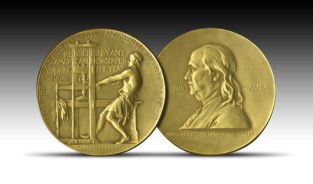
For those of you who have not been visited recently by Dream Thornton Wilder, let me catch you up. Son of the Midwest and global citizen, Thornton Wilder (1897-1975) had a gift for taking appallingly complex philosophical, moral, and historical topics and presenting them in works both approachable and relatable. A novelist and a dramatist, he is probably most known today for the play Our Town, the deceptively simple story of the citizens of Grover’s Corners, New Hampshire. Our Town scored the Pulitzer Prize for Drama in 1938. In his spare, non-Pulitzer-winning time, Wilder wrote novels, and his 1927 book The Bridge Of San Luis Rey won the Pulitzer Prize for the Novel. OOOPS. I made a mistake there. I meant in YOUR spare non-Pulitzer-winning time. Then, because everyone needs a hobby and his two other Pulitzers were lonely, Wilder picked up a third one in 1942 for the play The Skin Of Our Teeth. All of which leads me to wonder if Thornton Wilder ever dreamed about showing up naked for the Pulitzer Prize ceremony.

It’s sad, but even three Pulitzer prizes cannot keep an author on the top of the best-seller lists indefinitely. Now is a good time to confess that the only Thornton Wilder I have ever read is Our Town, and I have not read it in a long, long loooong time. However, since Our Town has ascended to Required Reading immortality, it feels like I read it every other year when I was in school. I’ve also seen it produced a few times. (Because the set for the play is a minimalist masterpiece consisting of a ladder and a couple of side chairs, Our Town is incredibly cheap to stage, meaning you can probably go see it at a high school near you right now.) Our Town tells the story of the intertwined lives of the Gibbs and Webb families in tiny Grover’s Corners, New Hampshire. The geography is interesting but ultimately irrelevant-Grover’s Corners could be any small town in any part of rural America in the years between the World Wars. In the traditional arc of events in a traditional life-graduations, marriage, parenthood-Wilder examines our relationship with our mortality and what is means to be resilient, not just in the face of personal tragedy, but in finding the strength to thrive in the banality of everyday life. It’s heady stuff, but Thornton Wilder sneaks past everyone’s Serious Drama Alarm System with the folksy, wry Stage Manager character. The Stage Manager guides the audience through the play, observing and commenting on the unfolding events in Grover’s Corners. He serves as the viewer’s advocate and representative on stage, right in the middle of that small town action. It’s a devastatingly effective way to involve an audience, and no matter how many times I have seen Our Town, it never fails to move me.

Our Town is a breezy read, and I really liked it every time I read it, but it hadn’t crossed my mind in a long time. I don’t even own a copy, which I discovered the morning after the Ghost of Thornton Wilder Past crashed my dream. I was a little embarrassed, and I hoped that Thornton Wilder would not show up again so I wouldn’t have to explain to him that he’d visited someone who didn’t even own ONE of his THREE Pulitzer Prize-winning works. (Seriously, y’all, Thornton Wilder will take every opportunity to bring up those Pulitzers. BRAGGY.) Off I went to the bookstore to remedy this glaring oversight. After hunting all over, I finally had to ask for assistance. A quick online search revealed that the only Thornton Wilder inventory in the store was one copy of Our Town in the Required Reading section.  It would seem that Thornton Wilder has fallen somewhat out of fashion. Clearly, the time is ripe for a whole Our Town branding reboot. Why not? Jane Austen’s well-manned Georgia era young ladies now genteely kill zombies. Abraham Lincoln is ridding frontier America of a vampire scourge. Isn’t it time for the citizens of Grover’s Corners to operate a training academy for international spies? Maybe it can be the location of a secret laboratory for the CDC where they research and cure all the urgent diseases and train international medical spies? Or perhaps the whole town collectively owns a maple syrup factory, which serves as a front for a safe house for international spies. I think you see where I am going with this.

pulizter

Picked up some souvenirs from the Columbia University bookstore.

I’m not sure what possessed Dream Thornton Wilder to show up in my head, but clearly, he was slumming. If he’s looking to stage a comeback, he is doing it all wrong. I mean, I appreciate the consideration, but this Tiny Book Blog isn’t exactly going to deliver a splashy re-entry. I know he’s dead, but I think even dead Thornton Wilder could score a seat on James Corden’s couch or the cover of People magazine.

#comebackdreams

Action Items
Thornton Wilder wrote the screenplay for one of the best Alfred Hitchcock movies, Shadow of a Doubt. Netflix and chill with that.

The Reason It’s Trivial

The following is a true story.

When I was but a fledgling reader, the one of the first book series I devoured was that classic of American classics, Laura Ingalls Wilder’s Little House On The Prairie. The books appealed to me because they were entertaining and pleasant, accessible because book Laura was about my age, but still alien because of the historical frontier setting. Laura was frustrated with her siblings, just like me! So relatable! She uses an outhouse, while I have modern plumbing! So exotic! Laura’s adventures in pioneering were engrossing but benign..until book four. Nothing in my short life had prepared me for the bombshell waiting in By The Shores Of Silver Lake.

As By The Shores Of Silver Lake begins,  the entire Ingalls family is recovering from scarlet fever. Times were hard on the prairie! So exotic!  Everyone miraculously survives, which isn’t how things typically went down in a pre-modern medicine world, but Laura’s older sister Mary is rendered blind by the disease. LIKE SHE JUST WAKES UP BLIND WTF. I was stunned. It wasn’t that I didn’t know that blindness existed. I just didn’t know that someone could just UP AND GO BLIND. WHY HADN’T ANYONE TOLD ME PEOPLE COULD JUST UP AND GO BLIND? Mary, of course, rallies to her circumstances, gathers her resources, and perseveres with the support of her loving family. Her inspiring example made me panic. I knew if I JUST UP AND WENT BLIND I would crumple like a piece of old tin foil. Even at a young age, I recognized my lack of internal fortitude. In my panic, I began to practice being blind so that if scarlet fever ever found me in the suburbs, I would be prepared. I ate with my eyes closed. I got dressed with my eyes closed. As it turns out, I was terrible at doing those things with my eyes closed, but one thing I got really good at was taking a shower in the dark. It took a while, but I got to the point that I could shower in the dark more efficiently than with the bathroom lights on. I practiced it so often that to this day, I shower in the dark. It just feels more natural. COME AT ME. PRAIRIE DISEASES. I AM READY.

True stories are sweepingly epic, or horrifying, or chilling, or heartbreakingly sad. (Or really dumb. See paragraphs 1-2.) Resultingly, true stories are great foundations for books, but a true story isn’t a guarantee of a great book. In the right hands, a well-told true story makes a book an equivalent of a phenomenal TED Talk-compelling and informative. In the wrong hands, you end up with a book equivalent of a toaster cooking demonstration-unnecessary and boring. What about a true story really matters? Does a story rivet a reader with insight, or stop a narrative in its tracks with irrelevance? These are the questions that authors struggle with. Unless, of course, the author is historian David McCullough.

David McCullough has told some of the most fascinating true American stories there are to be told. He’s been blowing the doors off American social history since his first book, The Johnstown Flood, was published in 1968. McCullough’s painstaking research marries with his lively storytelling style to make a convivial learning experience. He’s everyone’s favorite history teacher. His presidential biographies are enough to justify his formidable reputation (John Adams, Truman, Mornings On Horseback) but McCullough also tells larger stories about the unique experiences that contribute to the American identity. From the history of the Brooklyn Bridge to the year 1776 to American aviation, McCullough will entertain you and turn you into an armchair historian all in one book. You know where armchair historians are in demand? TRIVIA NIGHT. That’s right: David McCullough will make you smarter and more popular.

For maximum American history trivia answers packed into one true story, it’s hard to do better than McCullough’s The Greater Journey: Americans In Paris. America in the 1830s was a country on the move, busy building on the potential and the promises of the successful Revolution. A new generation took on the task of forging what it meant to be American by engaging in the time-honored practice of traveling abroad. In particular, Americans headed to Paris to take up residence, steep themselves in culture, and study and practice in their chosen fields. The result was an America that developed upon a foundation of New World democracy and Old World intellectual tradition. A thorough education was one that embraced the value of broadened horizons, so it was not unusual to spend multiple years in Paris before sailing back across the pond. Because David McCullough wants your team to win every single American history category including the double points round, this book delivers reams of trivia about notable Americans like Elizabeth Blackwell, James Fenimore Cooper,  and Oliver Wendell Holmes.

Of all the true stories that David McCullough tells in The Greater Journey, my favorite is that of Samuel Morse. Prior to The Greater Journey, the only thing I knew about Samuel Morse is that he invented the telegraph and Morse code and the only reason I knew that is because I read a million scrappy kid detective stories in which the scrappy kid detective, tied up and thrown into a closet/attic/cellar by the bad guy, gets rescued by tapping out a message in Morse code. As it turns out, before he invented the telegraph and detective rescue Morse code, Samuel Morse was a portrait painter. He went to Paris to improve his painting skills, and while there he spent hours every day at the Louvre, immersing himself in as much art as he could cram into his eyeballs. He distilled his time there in one of his most famous works, The Gallery At The Louvre, 38 of the Louvre’s most famous paintings rendered in miniature.  For Americans who did not have the means to experience the greater journey, Morse’s painting – and subsequently, Morse’s communication invention – closed unimaginable distances. If you can’t parlay all that Morse knowledge into a seat at the team trivia table, then you’re just not trying hard enough.

gallery_of_the_louvre_1831-33_samuel_morse

1830s Snapchat

Recently, some scrappy medical detectives published a paper recapping 10 years of research into Mary’s blindness. It turns out Laura’s true story about scarlet fever isn’t actually true, and the likely disease culprit is not scarlet fever but viral meningoencephalitis. The end result is the same: someone can up and go blind, so I’m still showering in the dark. It’s probably time to learn Morse code, too. Just in case.

#TeamMcCullough

Action Items
Medical detectives are awesome.  

Image of The Gallery of the Louvre 1831–33 is in the public domain {{PD-US}}

The Reason To Walk The Line

One of the fundamental expectations I have of the books I read is that in any given book, STUFF WILL HAPPEN. The plot, characters, story arc, theme, point-of-view….basic book guts should be present, accounted for, and delivering. Honestly, if I wanted nothing to happen in what I read, I’d stick to technical manuals and pre-screened credit offers. Having said that, I do have a threshold for the quality and amount of stuff that happens in a book. There’s a tipping point for when a story can feel overwrought and overdone. Simply put, there’s a fine line between dramatic and drama. Please allow me to illustrate:

The Cubs win their first World Series in 108 years in extra innings in a rain-delayed final game of the series? Dramatic.
People starting fistfights over discount sheets at Target on Black Friday? Drama.
Awaiting the first photographs of Jupiter from the Mission Juno spacecraft? Dramatic.
Any episode of any reality show that includes “big”, “fat” and/or “war” in the title? Drama.

Dramatic story elements are like cake. You can flavor them however you want, layer them for gravitas, and even carve them into weird shapes. Drama is the icing, piped on in swooshy swirls and decorated with sprinkles for flair and impact. Just enough of each makes you crave dessert, but too much and you’re looking at diabetes. Today’s roundup offers up some books that dance along that fine line and deliver a little of both.

Forward: A Memoir (Abby Wambach) Abby Wambach made soccer history repeatedly during her run as a power forward with US Women’s Soccer. Most goals scored in World Cup play? Check. 100 career goals scored? Check. World record for most goals scored (breaking Mia Hamm’s world record, NBD)? Check. Abby Wambach retired as a soccer player in 2015 with 184 career goals in international play, more than any player has ever scored-male or female. Her memoir begins and ends with soccer, laying out her tortured relationship with her body and how she translated that into the mind-blowing, powerful playing style that captured America’s attention. In her private life, Wambach grappled with revealing her sexuality to her family and her public, addictions to pills and alcohol, and a rocky marriage. Now sober and working for ESPN as an analyst and a contributor, Wambach’s memoir is less a reflection on a past long gone than a laying out of her strategy for tackling her demons in her future.
The Fine Line:
Dramatic After spending her post-high school graduation summer skipping workouts, drinking all the beer, and inhaling all the junk food, Wambach showed up for her first workout as a Florida Gator completely unprepared and out of shape. Knowing her spot on the team was on the line, she forces herself to get through drills so punishing that they made me nauseous just reading about them.
Drama Blow-by-blow, word-for-word recreations of looooong text exchanges with friends during personal crises.

Breakfast At Tiffany’s (Truman Capote) If you are only familiar with the movie version of Truman Capote’s novella, then what you’ve seen is a sanitized version of this story, cleaned up for a conventional 1950s audience. The book is infinitely more twisted. On the page, Truman Capote lets his bitch flag fly, and Truman Capote has a Ph.D. in Bitch Flag. Holly Golightly is an opportunistic country girl come to town, looking to make her fortune as someone’s wealthy wife in postwar NYC. Her story is told by her brownstone neighbor and friend, a man who at first observes Holly’s comings and goings and then becomes part of her inner circle. The first person narration puts us uncomfortably close as Holly jumps from various frying pans into various fires. For all her self-destructive faults, Holly possesses a shrewd charm that is just as compelling today as it was when this work was first published. All of Truman Capote’s contradictory longings for fame, social cachet, and privacy are manifested in this jewel box of a book.
The Fine Line:
Dramatic Holly’s touching, pure love for her brother Fred. He is never far from her thoughts and his well-being is her motivation as she looks for financial security.
Drama Holly forces her pet cat out onto the streets of New York to fend for itself because she and her cat are independent souls who “never made each other any promises.”

The Queen Of The Night (Alexander Chee) Generally speaking, you can’t get more dramatic than opera. Opera is the loaded double burger with cheese and bacon on the drama menu. The Queen Of The Night is an opera in novel form, with Alexander Chee delivering a life story so fantastic it’s just this shy of magical realism. Set in Paris during the Second Empire, under the reign of the Emperor Napoleon III and Empress Eugenie, The Queen Of The Night is a master class in social climbing, and falling, and climbing again. Our heroine, Lilliet Berne, is the toast of Paris, enjoying success and fame as a leading soprano. When she is offered the opportunity to realize every singer’s dream of originating a role in an opera written especially to showcase her talent, she agrees to meet with the composer to discuss the possibility. It is then that she discovers the novel on which the opera is to be based is actually her own life story. Lilliet’s quest to find out who spilled her secrets takes the reader through Lilliet’s very eventful life. There is just a whole lot of book going on here, and Chee ingeniously enfolds the tradition and elemental structure of opera into the story. I could not put this book down, but damn, it wore me out.
The Fine Line:
Dramatic Lillet’s childhood on a farm in Minnesota comes to an abrupt end when she is orphaned as a fever wipes out her family.
Drama Prussian soldiers invade Paris and Lillet escapes capture in a hot-air balloon.

Southern Living White Cake, Red Velvet, Peppermint, White Chocolate, Coconut

Burp.

Ultimately, drama tolerance is relative. Your mileage may vary, but there’s an immense literary satisfaction in indulging in juicy, well-executed drama. It’s the holiday season -indulge! Put on your biggest sunglasses, fling that long scarf back over your shoulder, toss your hair, and dive in. Act like you own the place.  It worked for Holly Golightly.

#fineline

Action Item
Maybe get a giant hat too. And a hot-air balloon. Just in case.

The Reason To Get Into The Groove

Once, I was invited to a really big birthday party. I’ll pause while you shake your head in disbelief, but hey, on occasion I slip past the deflector shields and make it onto a guest list. It was a big crowd, a surprise party, and I didn’t know most of the people there. I arrived alone and a little early (NERD ALERT), and the people that I did know that were attending hadn’t gotten there yet. So, rather than stare at the wall or eat all the tiny stuffed peppers out of anxious boredom, I struck up a conversation with a guy standing near me who also seemed a bit at loose ends (but it’s possible he was just eyeing the peppers too). After a quick exchange confirming exactly when we were supposed to yell ‘SURPRISE’ at the guest of honor, he started telling me how he spent his day, which had been a glorious stretch of hours during which he’d put some new parts on his motorcycle. He was really excited. He pulled out some pictures. Several pictures, in fact, of the bike before he’d put the new parts on, pictures of the parts themselves, and pictures of the bike after the parts had been added. As he warmed to his topic, he described the motorcycle parts in detail and why they mattered so much to his overall motorcycle experience. I tried to ask meaningful questions about what he was sharing, but my motorcycle knowledge is limited to the words “motorcycle” and “crotch rocket”, so I didn’t have much to contribute. Seventeen minutes after I’d started talking to this person, he didn’t know my name, but I knew every detail about his motorcycle transformation arc. Also, by this point, most of the tiny stuffed peppers were gone because the other people at the party knew a good appetizer when they saw it. We finally wrapped it up when we had to hide, a critical step in staging a surprise.

While it’s true that I don’t speak motorcycle, I didn’t need to in order to see that my party partner was sharing his passion. Everyone has their own thing, a thing that makes us so excited and eager that people will run if they see you getting fired up about it. Nobody in their right mind will talk to me about books, for instance. I’ve never gone as far as pulling out pictures of books when I talk about them but I’m not saying that won’t ever happen. (Unrelated note: follow Bookreasons on Instagram to see some dreamy pictures of books!) It’s one thing to verbally firehose everyone in your immediate vicinity with all of the ways you enjoy your favorite thing. It’s another thing entirely to make it a condition of any human interaction. There’s a thin line between enthusiasm and obsession, but you’d never prove that by the immersive Ready Player One, by Ernest Cline.

Ready Player One is Ernest Cline’s love letter to 80s geek and pop culture. Wait-strike that. Ready Player One is Ernest Cline’s ticker tape parade celebrating 80s geek and pop culture, complete with Tshirt guns and confetti cannons. Set in a grim future on an overpopulated Earth depleted of natural resources, Ready Player One tells the story of a society that has moved from the exterior to the interior. Virtual reality is the standard, with people spending as much time as possible strapped into full body suits logged into in a fantasy universe called OASIS. When the reclusive inventor of OASIS, James Halliday, dies and invites the whole world to compete to inherit his fortune in an elaborate 80s themed video game, the stage is set for some awesome 80s-style scrappy-underdogs-vs-evil-corporate-goliath competition.

You don’t have to be an 80s kid to enjoy this story. Ernest Cline has you covered even if you didn’t spend part of your childhood begging for an ATARI console or getting chased by PacMan ghosts. James Halliday is modeled on America’s Silicon Valley trajectory, a gifted programmer parlaying time spent tinkering with computers in his parents’ basement into a wildly successful industry and stratospheric personal wealth. In the three dimesional world, James is shy and awkward, finding interpersonal interaction painful. Inventing OASIS allows him to make his perfect reality over and over, as he programs planet after planet that recreate the late 70s and and 80s that he grew up in (my personal favorite being an entire planet consisting of video game arcade/pizza joints, and I want to go there because I hate waiting in line to play Tempest). Retreating into OASIS solves all of James’s social problems, but in his isolation, he’s unable to do the one thing that makes a personal passion so fun – share it with people that share his same devotions.  Upon his death, he’s finally able to get everyone to come to his playground. What would any of us do if we had the leverage to create the exact world we want, to engage with people in the way that makes us the most comfortable? James Halliday uses his money and influence to share everything he loves on the grandest scale possible.

Ready Player One is currently being turned into a movie by Steven Spielberg. I don’t usually get excited about movie versions of books I love, but OMG. I need Steven Spielberg to direct this 80s themed movie like I need air and regularly scheduled hair color appointments. I NEED it. I need all those 80s references filtered through the guy that gave us so much 80s culture. Interestingly, Steven Speilberg has said in interviews that he will not be referencing his own movies in Ready Player One. I don’t like telling Steven Spielberg how to do his job but he needs to change his mind on that. STAT. He’s going to leave Indiana Jones at the door? The Goonies? Whaaaat?

I suppose while I’m quibbling with Steven Spielberg on his directorial choices, I may as air my one tiny grievance with Ernest Cline. In the avalanche of dazzling 80s references in Ready Player One, there is not one appearance by the Material Girl. No Madonna. At all. I am calling a flag on that play and in the sequel I’d better see a Planet Madonna.

corman_8_watermark_madonna

Represent.

#livinginamaterialworld

Action Items
My personal Thanksgiving tradition is to re-read MFK Fisher’s The Gastronomical Me. I hope you get to enjoy your traditions this year. Have a safe & happy Thanksgiving Day!

Photo credit: Richard Corman for Rock Paper Photo

The Reason It’s Not In Order

There is an intended compulsivity to my To-Be-Read list. Theoretically, I read what’s on my stack in the order in which it was added to the stack. My books should all wait their turn behind the velvet line divider next to the sign that says “Wait Here For Next Available Associate”. It’s a neat, orderly procession because I don’t like my books to crowd me and line management is important. In theory, everything executes like clockwork, one of those Swiss clocks that is a marvel of efficiency and accuracy.

In practice, my To-Be-Read list is less a line of well-behaved books patiently waiting their turn than a crowd rushing the entrance of Toys”R”Us the day after Thanksgiving. There’s pushing, shoving, hair-pulling, and at least one fistfight. I want to be methodical and deliberate, I really do, because from the outside that approach seems marvelously productive. It’s a practice I have yet to translate into reality. For example, I’ve had Stacy Schiff’s The Witches on my list since the day it came out. That book is a straight-up diva though and I haven’t had the necessary uninterrupted time that a diva demands. Then there are my disappeared titles, because I lost my working TBR list in a disastrous iPhone update a few months ago so there are a bunch of books that I know I want to read but no longer know the names of. WHYYYY APPLE WHYYYY??? Then, of course, there are the books that are recommended to me by other enthusiastic readers. I get super pumped for those because sharing is caring and asking me to read a book you like is a secret mystery-coded message that says you like me BEST of all the people you know. It’s ok! I won’t tell anyone else that I am your favorite. If all of this feels like an elaborate justification as to why I just had to bump Mary Shelley’s Frankenstein to the top of the stack last week, well, your instincts are dead on.
Me: HAHAHAHAHA
Mary Shelley: Whut
Me: DEAD on. Get it??
Mary Shelley: Ugh

I suppose if any book is going to push to the front of the line with terrible manners and superhuman strength, it would be Frankenstein. The story behind the book is almost as famous as the book itself. In 1816, Mary Shelley and her husband the poet Percy Shelley were on an extended European tour, staying away from England for really good reasons that included avoiding Percy’s first wife Harriet, who was a tad cranky because Percy had run away with Mary while still married to Harriet. While in Switzerland, Mary, Percy, Mary’s stepsister Jane and their friends Lord Byron and John Polidori found themselves stuck inside on a rainy day. They challenged each other to tell ghost stories to pass the time and that was one hell of a one-up story session because that little party germinated both the vampire genre (hat tip to John Polidori) and the Frankenstein monster.
Percy: Whatcha doing Mary
Mary: BRB writing classic horror novel
Percy: Well “classic” might be premature—
Mary: also inventing science fiction
Percy: Okay, sure, it’s original but-
Mary: what’d YOU do today
Percy: whatever

I hadn’t read Frankenstein in a long loooong time and in truth, I didn’t read it that closely the first time. It was assigned reading in a British Literature class, a class in which the volume of assigned reading was honestly insane. The teacher’s approach was basically “British people wrote a lot of stuff. Let’s read all of it in two months.” It was all I could do to keep up with it. By the time that class was over, I was so burned out I hated England, Princess Diana, tea, Masterpiece Theater, and Monty Python. As a result of this shallow immersion, most of the Frankenstein lore I was carrying around in my head was supplied by Mel Brooks. (I’m not even sorry because Gene Wilder’s hair in “Young Frankenstein” is perfection.) When a friend told me she was reading Frankenstein for her book club and struggling a bit with it, I couldn’t abandon her to the wilds of English gothic horror. I had been there, and I have the scars to prove it. It was time to up-end my TBR stack yet again, stop skating on my sketchy, force-fed-British-Lit Frankenstein memories, and give that tall drink of mostly dead water the attention it deserved.

One trip to the used bookstore later, I was prepared to be scared. The Frankenstein monster we know, the force of nature that is a dangerous combination of brute power and pure instinct, is a creepy figure, but the Frankenstein monster in the book is actually far removed from today’s pop culture, neck bolt version. The monster’s creator, Victor Frankenstein, is an arrogant scientist who single-mindedly pursues the ultimate scientific challenge – creating life in inanimate tissue. Once he reaches his goal, he abandons his creation, unable to come to terms with the ramifications of his actions and unwilling to accept responsibility for his profound discovery. Mary Shelley curses her monster with self-awareness, a being who is unable to feel gratitude for the life he was given because he knows he is ultimately not of the world that he’s living in. This book is wildly modern, and the questions Mary Shelley raises about the ethical pursuit of knowledge are even more relevant now. I was also stunned at what a huge whiny man-baby Victor Frankenstein is. I missed that completely the first time around. I was rooting for the monster, frankly.
Mary: Me too TBH
Me: Right??

the-inheritance

Stackus Interruptus.

My TBR stack is still a work in progress, a messy monster of my own creation. After I finished Frankenstein, I went back to the next book in the stack and promised myself no more interruptions. I’d completely forgotten that Charles Finch’s new one in the Charles Lenox series, The Inheritance, came out this week. Ooops. Charles Lenox has VIP status at my club so he always goes to the front of the line. I’ll get back to the stack right after I finish it.

#frontoftheline

Action Items
You might be able to catch the National Theater Live’s version of Frankenstein. It’s making encore rounds now. Check it out here.

The Reason For Full Disclosure

Out of all the things that make me really uncomfortable (spiders, tax forms, Hiddleswift), nothing induces as much squirming as the thought of navigating the complex landscape of real estate. I’m not really the detail-oriented type who can’t wait to purchase a house. It feels like a system set up to make me fail. I marvel at the intrepid homebuyers on HGTV. They aren’t afraid of anything. They just march into house after house, joyfully embracing discussions about open floor plans and masters on the main and common areas. I’m always baffled when the production-driven nitpicking starts. The doorways are too big or the floor is too shiny or the bathtub isn’t big enough to bathe the family llama. These places look great to me when they apparently are actual landfills filled with medical waste and the tears of interior decorators. Since I’m missing all the flaws that are painfully obvious to even the most novice HGTV homebuyers, I’m probably unqualified to successfully find a domicile in real life. Then, there is my fear that I would accidentally buy a haunted house. That is a real fear. It happened to those people in Amityville. I read all about it.

The Amityville Horror tells the Very True (cough, cough, ahem) story of the Lutz family, who purchased the most pig-haunted, hostile-fly-infested, demon-y house available in Amityville, Long Island, in December 1975. The house was the site of six horrific murders in November 1974,  only 13 months prior to the Lutz family moving in.  After enduring 28 days of torment at the hands of vengeful, disturbed ghosts, the Lutzes abandoned the house, leaving their possessions and fleeing in the middle of the night. They did not “move out” so much as escape. The book about their reported experience was published in 1977, was a sensational bestseller, and spawned a series of informative movies about how to live in a haunted house. The debate about whether or not the haunting was real, if the family actually experienced genuine ghost harassment, continues today. I have an entirely different theory, however. I might be alone here, but I am pretty sure The Amityville Horror isn’t about demons crossing back over to play with human emotions. It’s about real estate anxiety. A LOT of real estate anxiety.
Real Estate Agent: This room could be used as an office
Me: Nice
Real Estate Agent: Or to talk to the dead
Me: What?
Real Estate Agent: Nothing

I read the book at a very impressionable age, by which I mean when I was in fifth grade I stole it out of a stack of paperbacks that belonged to my parents. (The undeniable allure of the Forbidden Grown-Up Book Stack is also responsible for my reading The Godfather, but we’ll talk about that book and my propensity for petty book theft another day.) Even to my juvenile eyes, the book was pretty lurid. I comprehended that it was dumb to believe that a house was being haunted by an evil pig named Jodie, but I was very concerned about the possibility that my personal house might be targeted by red-eyed evil Jodie haunting pigs just because I’d read the book. How can you even tell if an evil pig is loitering in a potential home purchase? Or any home, for that matter? I’m fine with chihuahuas or urban chickens or komodo dragons, but I am drawing the line at unfriendly bacon with an agenda. Had my parents failed to do their research when buying the house we were in? I couldn’t ask them because no way was I going to confess that I’d pilfered a book from the forbidden zone. I was just going to have to be on permanent, hyperalert guard for disembodied voices telling us to “get out”.
Real Estate Agent: Look at this lovely open floor plan
Me: What does that mean exactly
Real Estate Agent: You can fit a lot of evil ghost pigs on this floor
Me: Ah

Everyone likes a bargain, and everyone wants to get the most house for the least money. But if the house you are buying is a crazy deal because people were recently murdered there, then maybe it’s not the best time to enter the housing market. Sadly, the Lutzes did not heed this advice. Sidebar question: does this advice seem unreasonable to anyone? From where I sit “don’t get the murder house” doesn’t seem controversial or even provocative, but apparently the only response to “Maybe get a different house than that recent crime scene one” is “HOW DARE YOU EVEN SUGGEST I NOT BUY THAT HOUSE” (throw money at real estate agent). It’s a homebuying shortcut that I am not willing to entertain.

house-for-sale-sign

This is a good start but I have some follow-up questions

The Amityville Horror is a worst case real estate scenario, second only perhaps to that vampire castle in Romania. The Lutzes were only trying to find a place to raise a newly blended family. Finding a place to live is hard, and finding a demon-free place that you think you might like is just an invitation for the universe to be a jerk by: 1. Make everything in your new place break, often simultaneously and 2. Make you hate everything in your place, often simultaneously, requiring expensive and endless renovations. Either way, you’re under attack by otherworldly forces trying to steal your soul. It’s enough to make staying in your parents’ basement look appealing forever.
Contractor: We’re here to tear up the floor
Me: (screams in terror)
Contractor: I get that a lot

The universe is a jerk when it comes to reading stolen books, too. About halfway through the chunky paperback of The Amityville Horror, I was reading about how the family was plagued by swarms of flies inside the house. The haunted drama created by the menacing Amityville fly gangs had me totally transfixed. I was therefore unprepared when I turned a page only to find that at some point an actual fly had become trapped in the book and entombed, completely flattened out like a creepy fly zombie bookmark. I threw that book across the room so fast it would have registered on a radar gun, grabbed my shoes, and fled my house for the sunny, safe outside. I get you, Lutzes. Bookreasons OUT.
Contractor: Question about interior paint
Me: Ok
Contractor: Should the color match the red of the blood dripping down the walls?
Me: YES. I love holistic design

#fulldisclosure

Action Items
If you like haunted house novels that are actual fiction, I recommend Slade House by David Mitchell. It’s 100% fly free.