The Reason You Should Pass The Tissues

I like to pride myself on my stoic, even-keeled approach to life, but that is a giant lying waste of time because I am an emotional emotion who goes around emoting all the time. I wouldn’t know stoic if it bit me on the ass and offered me a Band-Aid. Interestingly enough, though, I am not much of a crier. It’s not that I don’t feel sadness, it’s that I’m shallow and mostly dead inside. I don’t feel a LOT of sadness before I get distracted by jazzier feelings, like sulkiness or enthusiasm or hungry. The result of all this diversion and denial is that a lot of my crying gets done as a result of book ambush. There I’ll be, reading a perfectly innocent book, when I unexpectedly get jumped by the major sads. It can make reading in public a little tricky, but I’m a razor’s edge kind of gal. Sometimes, a catharsis via a good cry is what’s called for, even when it’s terribly inconvenient to fall apart in my dentist’s waiting room.

There are books that have made reputations by the epic sobfests they instigate. Where The Red Fern Grows. The Color Purple. Charlotte’s Web. Whichever Harry Potter book where Snape dies. I didn’t cry while reading any of these. They barely ranked a “Watery Eyes” on my personal Cry-O-Meter, but the titles listed below? My Waterloos. Let’s face them.

John Adams by David McCullough

Learning about the American Revolution sounds exciting until you realize that a lot of the American Revolution is about meetings. I don’t care if you give your meeting a fancy name like “Continental Congress”. It is still a MEETING and the only thing more boring than going to a meeting is learning dates in the 1770s when other people held meetings. The only exception to this rule is if David McCullough writes a book about the meetings. (Sorry, Lin-Manuel Miranda.) I can go on and on about David McCullough’s books (and one day I will) and his masterpiece John Adams is the American Revolution story we all deserve. This definitive biography of America’s second president is enthralling, with a sexy love story and political intrigue and an honorable, intensely principled central character. I was so absorbed by  David McCullough’s charming and sympathetically rendered portrait of John Adams, and so delighted by the details of Colonial life and times, that I was completely unprepared for John Adams to die. On the 4th of July. And the 50th anniversary of the adoption of the Declaration of Independence. AND ON THE SAME DAY AS HIS BESTIE THOMAS JEFFERSON. Are you kidding me with all this? As I was hard weeping my way through this part of the book, my husband heard me crying and came to check on me.
Husband: Are you ok? What happened??
Me: (sniffles) John…Adams…diiiiieeeeed (fresh weeping)
Husband: John Adams? Federalist John Adams?
Me: (closes eyes, nods)
Husband: (makes disgusted noise and leaves)

Cleopatra: A Life by Stacy Schiff

Stacy Schiff’s superpower is research. More accurately, it is researching the unresearchable. She should have a place in the Marvel Universe for this because it’s at least as difficult as using archery to defeat robot armies. It is this remarkable, non-archery ability that delivered the book Cleopatra: A Life into my hot little hands. When you hear ‘Cleopatra’, what comes to mind? That’s right—Elizabeth Taylor’s questionable style choices and something vague about a snake. For all Cleopatra’s fame, very little was documented about Egypt’s defining monarch, until Stacy Schiff came along to do all the heavy lifting. For gaps where records about Cleopatra do not exist, Stacy Schiff’s meticulous research fills in with fascinating details about Egyptian history, culture, and what it meant to be a member of the royal family in power in Ptolemaic Egypt. Cleopatra was strong ruler dedicated to the welfare of her kingdom, but it was her alliance-turned-love-affair with Mark Antony that gives this biography a powerful emotional thread. Cleopatra and Marc Antony seal their fates when they unwisely take on the Roman Republic. After losing the final, decisive battle against the Roman leader Octavius, Marc Antony commits suicide. The description of Cleopatra recovering her beloved husband’s body and bringing it home to be with her prior to her own suicide is nothing short of heartbreaking. Cleopatra’s devastation and desperation as she prepares to take her life – I cracked while I read this. And it wasn’t pretty weeping, either. It was a big old ugly cry, the kind where your lashes get so wet it feels like your mascara is running right off even though you’re not wearing any mascara. That is the blurb this book needs: “I cried my imaginary shadow mascara right off my face”.


cucumber

Book reading supplies: Bookmarks, comfy chair, cucumber for puffy eyes


Love Is A Mix Tape: Life And Loss, One Song At A Time by Rob Sheffield

Just typing the title of this book makes a lump well in my throat. Rob Sheffield, a music and culture critic for Rolling Stone, wrote this memoir about meeting, falling in love with, and marrying the perfect girl while a student at the University of Virginia. It is a love story about how complicated dating life can be, about marrying young and loving the intimacy of married life, and about reeling from the sudden, crushing loss of that intimacy. Rob and his wife Renee were married five years before their life together abruptly ended when Renee died from a pulmonary embolism at the age of 32. Rob Sheffield processes his shock and grief by losing himself in the 90s music that brought them together, telling the story of his life before, during, and after Renee. He sugarcoats nothing in this book, laying bare the bewildered anger and aimlessness he felt after his wife’s death, all the sadder for its contrast with the contentment and joy he found in his relationship with Renee. This book took me beyond ugly crying into showoff crying. I went for the sustained, constant quiet sobbing for the entire second half of the book, and because I just could not believe that Renee died. I kept interrupting myself to go read that part again. It’s a beautiful, moving, and brave book.

#bookambush

Action Items
Honorable crying mention goes to the part of Little House On The Prairie when Laura’s dog Jack dies.

The Reason I Prefer Limericks

Are you entertaining entering the glamorous world of liberal arts and becoming an English major? There is a lot to ponder (what color ink should you choose to take notes? what will your unifying design theme be for your iPad and iPhone cases?), but it really comes down to whether or not you’re ready to embrace the fundamentals. Let me break it down for you. As a literature student, you have two jobs. The first job is to read everything assigned to you to read. Never mind that sometimes your reading list is a brain-baffling tossed salad of German postmodernism , world mythology, and John Milton. Nobody is asking you what you want to read. You’re reading what’s on that syllabus, so hush your mouth, put down that People magazine, and pick up that Bertolt Brecht.

Once you’ve read your assigned works, you might think you’re done. Well, you’re not, because that’s when you start your shift on your second job, which is to get your analysis on. Unleash your powers of perception and persuasion and run the time-honored drill of writing a paper. The act of writing a paper demonstrates understanding of the text, grasp of the larger ideas and context around the work you just read, and that you know how to procrastinate to a point where it becomes necessary to read The Grapes of Wrath, draft an outline, and write a paper about Steinbeck’s use of grapes as a motif in the 48 hours before the due date. Or maybe I wrote about Steinbeck using wrath as a motif? I’m not sure, as I was hallucinating by hour 37.

For the opinioned among us (looks in the mirror, points to self), crafting and writing papers is a rewarding exercise. I thoroughly enjoy making juicy literary arguments and I can cite more sources than a Kardashian has eyeliner. Fiction, non-fiction, plays, short stories, novellas, fairy tales–bring it ON. Notice anything missing from that list? I’ll fill you in. POETRY. I don’t know why, but I am incapable of articulating anything insightful about poems. It’s not that I can’t enjoy poetry. It’s that I can’t explain it. When obligated to describe why a poem has a particular quality, I’m stumped. It just comes out as “Nice letters make good word poem picture”,  and the only thing exaggerated about that example is that it’s giving me more analytic credit than I deserve. I dreaded assignments requiring any analysis of any poetry.  I once punted so hard on a paper about Robert Frost’s “Stopping By Woods On A Snowy Evening” that my teacher took me aside to ask me if everything was okay. I think she suspected me of having someone else do the assignment for me and was wondering why I’d hired a kindergartner. Sadly, that’s when I had to face an unpleasant truth: I would never be a poetry whiz. I’d never be in the same class as the amazing Edna St. Vincent Millay.

Edna St. Vincent Millay was a Jazz Age writer, activist, and all-around badass. How badass, you ask? Okay: She was a Maine native, Pulitzer Prize-winning celebrity poet, and named after a hospital. BIO BONUS LEVEL UNLOCKED. POINTS AWARDED, EDNA. Where Zelda Fitzgerald embodied Jazz Age liberation as a volatile live wire, celebrating conspicuous consumption and inebriated recklessness, Edna St. Vincent Millay was cooler than the other side of the pillow.  Independent, willful, and insanely talented, she lived an unconventional life characterized by artistic integrity and intellectual curiosity. And sexual curiosity. Let’s just say all the curiosity.

Savage Beauty is the gorgeous biography about Edna St. Vincent Millay by Nancy Milford. It does ESVM’s life justice (Four-initial monogram? Badass) spanning her early, poverty-stricken years in rural Maine, her boldness as a Vassar student, and her amazing career. All of that is interesting enough, but Milford’s meticulous research reveals an Edna who is lively, stubborn, and driven by her passion for the arts and for artists. ESVM was a born writer, composing opera librettos and plays, but it is her poetry that casts the longest shadow.

Generally, my ability to appreciate poetry is limited to crying at a well-placed poem at a movie funeral. (And you know I just paused to watch John Hannah read W.H. Auden’s “Funeral Blues” in Four Weddings and a Funeral. And now you’re pausing to do the same thing. I’ll wait. It’s a good scene.) There is one exception to this sad rule, and that is the sublime, brilliant ESVM poem “Renascence”.  Written when Edna was a teenager, she submitted in a national poetry contest, where it was awarded 4th place instead of an expected 1st. The ensuing “she was robbed” controversy was Edna’s first exposure to poetry fame and facilitated a full scholarship to Vassar. “Renascence”  is ambitious in scale and subject matter. Over 200 lines long, it is written in the first person, with the narrator reconciling her feelings about feeling overwhelmed and lost in a vast world. It is almost prose, almost a short story, both intimate and sweeping with a sermonlike momentum. I’ve loved it since I first read it. It’s fortunate that it’s a good, long, juicy, solid poem because it has to stand in for all the other poems that I avoid like the plague.

Like all masterpieces, “Renascence”  is deceptively simple. It’s both challenging and comforting, begging larger thematic questions (immortality and stuff) while grounding itself in a natural, mountainside setting. The real magic of “Renascence”, though, is that I never had to write a paper about it, so I never ruined it for myself or anyone else. (Um, until today.)  My poetry bandwidth is just too narrow. Trying to pin down ESVM poetic genius for research posterity would have been like trying to hammer a nail with a baguette: crumbs everywhere and a really annoyed nail.

poetry

Poetry analysis toolkit

I’m definitely calling in sick at the second job today.

#poetrybandwidth

Action Item
Nancy Milford writes stupendous biographies. Sadly, she has written only two–Savage Beauty, and Zelda. You go read them while I sit here and wish for her to publish another one, preferably about Zora Neale Hurston or Dorothy Parker.


The Reason To Take It Easy

Happy Fall! Bookreasons has pressed ‘pause’ and is on a fall break this week. If you’d like to see what is keeping me occupied, follow me on Instagram @bookreasons. It’s Bookreasons: Free Range Edition!


img_0345

Crate training Dickens.


Upcoming, we’ll be talking about ragereading, sexy Presidential history, and how I am terrible at poetry . In the meantime, tell me in the comments what you’re reading right now!


The Reason It’s An Emergency

Have you seen me? I will save you some time. No, you have not seen me, because I have recently been taken hostage. Not that any of you have noticed my crisis literary situation. What, exactly, does it take to create a sense of urgency here? I need to be rescued before it’s too late. Since nobody understands how dangerous this situation is, I am taking matters into my own hands and executing a really flashy rescue operation. Like, Kiefer Sutherland combined with Agent Carter levels of flashy. FLASHY.

Why is all this necessary? Well, a few weeks ago, I obtained the book The Last Policeman by Ben H. Winters. I bought it accidentally (and lest you think I am repeating myself, I am. I also told this story here. Pipe down. This is MY rescue operation and it requires exposition.) The Last Policeman, as I soon discovered, is both a science fiction book and the first book in a trilogy. Seriously, I was pissed. I don’t SciFi and I didn’t have time to indulge my book OCD with a trilogy because I am very busy and important. I figured I had a hateread on my hands because I always know everything. Like Grace Kelly pumping her own gas, I decided to rise to the occasion, plaster a smile on my face and read it.

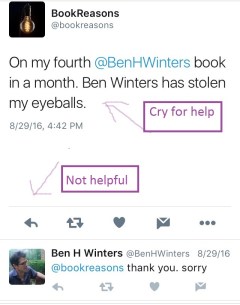
I could not put down The Last Policeman. I hid from people so I could finish it uninterrupted. Subsequently, I picked up the next book in the trilogy…then the third book…and I was through the looking glass, people. It is Bookreason’s policy to never negotiate with novelists, but I have no choice. I’m never getting out of here otherwise. Here is a rundown of my Ben H. Winters takeover.

The Last Policeman  The gateway book. Police officer Henry Palace is promoted to detective in his small New Hampshire town at the same time it’s determined an asteroid is on a direct collision path with Earth.

Countdown City The asteroid gets closer. There’s less time on everyone’s clock. Henry Palace agrees to help a friend search for her missing husband.

World Of Trouble Time has almost run out. Henry Palace attempts to hold on to his only family by trying to save his headstrong, reckless sister from herself.

One of the enjoyable, almost comfortable aspects of reading a series – crime series in particular – is getting to know a particular set of characters as they navigate through different circumstances. The settings for the character roster change; the behavior of the characters does not. There is always a definite cast of folks you expect popping up in each book. The wise, world-weary mentor, the hot mess best friend, the crazy but insightful neighbor…you get the idea. Ben H. Winters, however, does not. Ben H. Winters gives no fucks about making you feel comfortable or familiar with recurring characters in The Last Policeman series. Instead, he threads this series together by asking the same question of the main character over and over: How do you live your life when the apocalypse is no longer abstract, but has a precise date and time? Henry Palace is left to navigate his new world in surprising, subtle, subversive ways. These books just flat refuse to be predictable.

After finishing  The Last Policeman series, I figured I was done with Ben H. Winters and moved on to my next book. Turns out it wasn’t my decision any more. Not even reading Elena Ferrante (My Brilliant Friend, for the record) could knock World Of Trouble out of my head. I had checked into the Hotel Ben-ifornia. I can check out anytime I like, but I can’t never leave.

Underground Airlines What if the United States never fought the Civil War? What if slavery were legal today, right now? This book imagines that grim alternate outcome in an America hard divided by a Mason-Dixon line that’s a border with checkpoints. Underground Airlines is a gut punch. Ben H. Winter’s worldbuilding is frighteningly specific, laying out a whole history that begins with the Lincoln administration, Supreme Court rulings that cement slavery into the identity of the U.S., and a present-day culture of complacency, enforcement, and protest. The Underground Airline is the escape route out of states where slavery is legal, and the story centers around a US Marshals agent,Victor, whose job it is to track down and return escaped slaves. The reason Victor has this job, and how he goes about doing it, makes for a riveting, thoughtful, revolutionary look at the soul-killing compromises we as humans accept to make the unthinkable normal.

Bedbugs After I finished Underground Airlines, I grabbed Bedbugs. Because at this point, I have Stockholm Syndrome, and if it’s not a Ben H. Winters book I don’t know how to read it. The moral of the Bedbugs story is, if you find an amazingly great apartment in Brooklyn, it’s only because those Rosemary’s Baby people couldn’t afford Manhattan anymore and had to set up in an outer borough. It’s a trap, people. Settle for the 1BR basement place that smells like cabbage. You will be better off. This book is seriously creepy and a perfect read for Halloween season. Also, if you don’t like bug stuff, stay the hell away from this book. I don’t like bug stuff, but Ben H. Winters doesn’t care. I had to read it anyway. Because that is how it goes when you’re a literary hostage.

winters-tweet

You know what, y’all? He’s not really that sorry.


Using all my copies of Ben H. Winters books, I have managed to spell out S O S so when the search planes fly over, they’ll be able to spot me. I’ve also managed to untie my hands so I can tap out a signal on the window in hopes someone will hear me (which is an actual thing that happens in one of the books listed here. EASTER EGG, BITCHES)

#sos

Action Items
Read Underground Airlines. Seriously. Like right now.

The Reason For Full Disclosure

Out of all the things that make me really uncomfortable (spiders, tax forms, Hiddleswift), nothing induces as much squirming as the thought of navigating the complex landscape of real estate. I’m not really the detail-oriented type who can’t wait to purchase a house. It feels like a system set up to make me fail. I marvel at the intrepid homebuyers on HGTV. They aren’t afraid of anything. They just march into house after house, joyfully embracing discussions about open floor plans and masters on the main and common areas. I’m always baffled when the production-driven nitpicking starts. The doorways are too big or the floor is too shiny or the bathtub isn’t big enough to bathe the family llama. These places look great to me when they apparently are actual landfills filled with medical waste and the tears of interior decorators. Since I’m missing all the flaws that are painfully obvious to even the most novice HGTV homebuyers, I’m probably unqualified to successfully find a domicile in real life. Then, there is my fear that I would accidentally buy a haunted house. That is a real fear. It happened to those people in Amityville. I read all about it.

The Amityville Horror tells the Very True (cough, cough, ahem) story of the Lutz family, who purchased the most pig-haunted, hostile-fly-infested, demon-y house available in Amityville, Long Island, in December 1975. The house was the site of six horrific murders in November 1974,  only 13 months prior to the Lutz family moving in.  After enduring 28 days of torment at the hands of vengeful, disturbed ghosts, the Lutzes abandoned the house, leaving their possessions and fleeing in the middle of the night. They did not “move out” so much as escape. The book about their reported experience was published in 1977, was a sensational bestseller, and spawned a series of informative movies about how to live in a haunted house. The debate about whether or not the haunting was real, if the family actually experienced genuine ghost harassment, continues today. I have an entirely different theory, however. I might be alone here, but I am pretty sure The Amityville Horror isn’t about demons crossing back over to play with human emotions. It’s about real estate anxiety. A LOT of real estate anxiety.
Real Estate Agent: This room could be used as an office
Me: Nice
Real Estate Agent: Or to talk to the dead
Me: What?
Real Estate Agent: Nothing

I read the book at a very impressionable age, by which I mean when I was in fifth grade I stole it out of a stack of paperbacks that belonged to my parents. (The undeniable allure of the Forbidden Grown-Up Book Stack is also responsible for my reading The Godfather, but we’ll talk about that book and my propensity for petty book theft another day.) Even to my juvenile eyes, the book was pretty lurid. I comprehended that it was dumb to believe that a house was being haunted by an evil pig named Jodie, but I was very concerned about the possibility that my personal house might be targeted by red-eyed evil Jodie haunting pigs just because I’d read the book. How can you even tell if an evil pig is loitering in a potential home purchase? Or any home, for that matter? I’m fine with chihuahuas or urban chickens or komodo dragons, but I am drawing the line at unfriendly bacon with an agenda. Had my parents failed to do their research when buying the house we were in? I couldn’t ask them because no way was I going to confess that I’d pilfered a book from the forbidden zone. I was just going to have to be on permanent, hyperalert guard for disembodied voices telling us to “get out”.
Real Estate Agent: Look at this lovely open floor plan
Me: What does that mean exactly
Real Estate Agent: You can fit a lot of evil ghost pigs on this floor
Me: Ah

Everyone likes a bargain, and everyone wants to get the most house for the least money. But if the house you are buying is a crazy deal because people were recently murdered there, then maybe it’s not the best time to enter the housing market. Sadly, the Lutzes did not heed this advice. Sidebar question: does this advice seem unreasonable to anyone? From where I sit “don’t get the murder house” doesn’t seem controversial or even provocative, but apparently the only response to “Maybe get a different house than that recent crime scene one” is “HOW DARE YOU EVEN SUGGEST I NOT BUY THAT HOUSE” (throw money at real estate agent). It’s a homebuying shortcut that I am not willing to entertain.

house-for-sale-sign

This is a good start but I have some follow-up questions

The Amityville Horror is a worst case real estate scenario, second only perhaps to that vampire castle in Romania. The Lutzes were only trying to find a place to raise a newly blended family. Finding a place to live is hard, and finding a demon-free place that you think you might like is just an invitation for the universe to be a jerk by: 1. Make everything in your new place break, often simultaneously and 2. Make you hate everything in your place, often simultaneously, requiring expensive and endless renovations. Either way, you’re under attack by otherworldly forces trying to steal your soul. It’s enough to make staying in your parents’ basement look appealing forever.
Contractor: We’re here to tear up the floor
Me: (screams in terror)
Contractor: I get that a lot

The universe is a jerk when it comes to reading stolen books, too. About halfway through the chunky paperback of The Amityville Horror, I was reading about how the family was plagued by swarms of flies inside the house. The haunted drama created by the menacing Amityville fly gangs had me totally transfixed. I was therefore unprepared when I turned a page only to find that at some point an actual fly had become trapped in the book and entombed, completely flattened out like a creepy fly zombie bookmark. I threw that book across the room so fast it would have registered on a radar gun, grabbed my shoes, and fled my house for the sunny, safe outside. I get you, Lutzes. Bookreasons OUT.
Contractor: Question about interior paint
Me: Ok
Contractor: Should the color match the red of the blood dripping down the walls?
Me: YES. I love holistic design

#fulldisclosure

Action Items
If you like haunted house novels that are actual fiction, I recommend Slade House by David Mitchell. It’s 100% fly free.


The Reason To Polish My Trophy Case

For a very long time, it did not occur to me not to read any book I started cover to cover.  I didn’t know I didn’t have to finish. Never giving myself permission to put a book down means I’ve done some serious hatereading. (Hatereading is my least favorite kind of reading. It ranks below carsickreading and interruptedreading.) It’s not like I’m going to qualify for the ‘Always Finishes The Book’ Prize because it doesn’t exist and there’s no scoreboard for it anyway. No one is keeping book scores except for the unreasonable compulsive asshole who lives in my head, and she should shut up. Letting meanless scorekeeping sabotage my Main Fun Thing by sucking all the fun out of it is somewhat shortsighted.  Reluctantly, but necessarily, I have given myself an out in some specific instances when it becomes clear and a book and I are not compatible. Even though the breakups are handled gently and with respect – I always take the book out for coffee, and I NEVER give the bad news over a text message -there is a little part of me that feels like I let the book down. Please join me as we twirl around like happy autumn leaves in a mini tour of my Hall of Shame.

The Girl With A Dragon Tattoo I tried with this book. Twice. I still can’t believe I could not finish it. TWICE. The Girl With The Dragon Tattoo has all of my Basic Crime Fiction requirements: down-on-his-luck grizzled male narrator, badass female protagonist, and a film adaptation starring Daniel Craig. When I first picked it up it seemed Smilla’s Sense of Snow-ish, and I was down with that because I loved that book. When I could not get into it, I figured I was just was not in the mood in that moment to feel Swedish so I put it aside. Then suddenly everyone I knew had read it and then the movie was announced then everyone had read the second book in the series I was all, ok, what the hell am I missing here? I hunted up my copy, took it with me on a vacation, and I cracked it poolside. It was slow going but I kept telling myself it was going to get better! Any page now! After I’d been at it about half an hour, the friend I was with said “OH MY GOD WHAT IS WRONG YOU KEEP MAKING SIGHING NOISES EVERY FIVE MINUTES STOP IT RIGHT NOW OR ELSE.” My involuntary breathing hated the book as much as I did, and my friend hated my exasperated sighing. It was time to bail. Sorry, Dragon Tattoo. I wanted it to work out as much as you did.

The Hunt For Red October Like The Girl With The Dragon Tattoo, Tom Clancy books qualify on paper as something I would really enjoy. (pause to hold for laughter at my awesome play-on-words-paper joke) But I bailed on The Hunt For Red October in the middle of a 3-page description of…omg, something about sonar? I leave these books for the gearheads who can truly appreciate the magic of a dimly lit submarine full of gauges, each requiring their own lovingly detailed description of detail-y details. Gauge on, my gearheads.

20,000 Leagues Under The Sea Ok, you got me. I did not bail on this book. I’m just here to say I am never ever going to read it ever. This book has a giant squid in it, and I don’t read about spiders. I know a squid is not a spider but it’s close enough because 8 legs and squids are WORSE because suction cups all over the legs. The only book I have ever read about a spider was It and that is only because I DID NOT KNOW Stephen King was going to go all giant town-eating spider on my ass and by the time I figured it out I was too far into the book to stop. That is the last time I let Stephen King bait me with a serial killer clown and switch me to a sewer-dwelling Charlotte with a gland problem. In fact, consider this whole paragraph my official request that bookstores have an Octopod/Arachnid section where all books even remotely related to spiders or squids are shelved. This will make it convenient for me to never get near that section.

Eat, Pray, Love  I know. You loved it. Your friends loved it. Everybody everywhere loved it. I tried. I really did. I’m dead inside. I donated my copy to the library so everyone can continue to love it.

A Brief History Of Time Shut up. You didn’t finish it either.


ribbon

Thanks for playing.

It can be difficult to tell when it’s not working out with a book because sometimes my best reads are the ones that made me work a little. When I find myself fantasizing about accidentally dropping a book off a roof, I know it’s time to break up. It’s ok. We can’t make it across the finish line every time! I’ll pick up my participation trophy on the way out.

#hatereading

Action Items
Book breakups are hard. Give yourself time to grieve.

Image courtesy Creative Commons

The Reason To Avoid That Bridge

There is a certain kind of personality that thrives on chaos, a personality who sees interactions with other people not as an opportunity to discover and appreciate the human experience, but as pure combat. It’s about getting a reaction, and the bigger the rise, the bigger the win. We all know these people. Like your gross uncle at Thanksgiving who can’t stop making fart jokes at dinner, these people have no sense of what’s appropriate and revel in creating discomfort, pulling out all the shitty stops to ensure that everyone pays attention to them. Scientifically speaking, these people are referred to as “jackasses”. Encountering jackasses used to be a matter of chance; you may or may not have run into one going about your day, and once identified, you could take pains to avoid them. (Unless your mom put you in the buffer seat next to your uncle at Thanksgiving. Sorry your mom did that.) However, the advent of social media provides almost daily exposure to particularly malevolent folks who practice their jackassery scorched-earth style. You see them in the comments section on YouTube, you see them shutting down conversation threads on Facebook, you see them starting flame wars on Twitter. I am talking about the trolls, and whenever I see a troll in action, I always think of Iago, that king of all trolldom from Shakespeare’s Othello.
Iago: What’s that thing?
Me: My laptop
Iago: Can I kill people with it
Me: Damn Iago not everything is a thing to kill people with

Othello tells the story of one man’s obsession with…well, obsession. Othello, an experienced soldier, is regarded highly by his peers and his superiors. As the play opens, the audience is introduced to Othello via a conversation between Othello’s fellow soldiers Iago and Roderigo, who discuss Othello’s new marriage to an adoring wife, his prowess as a soldier, and his skill as a leader. They are really happy for Othello and wish him all the best. HAHAHAHAHA just kidding. Roderigo’s pissed that Othello married the girl Roderigo wanted, and Iago’s pissed because—well, Iago’s just pissed, and he is not going to take Othello’s general success and popularity lying down. He takes some time to lay out his detailed plan to ruin Othello’s life by lying, manipulating, and generally gaslighting Othello (and everyone Othello knows and trusts). This is Iago’s show, and Othello is just living in it. While he would have been very effective behind a keyboard, Iago trolls the old-fashioned way – face to face –  but he gets it done just fine. Long held as one of the most repulsive characters in literature, Iago’s reason for wanting to destroy Othello is a disturbing and pathetic “just because”.
Iago: The means totally justified the ends
Me: That is not how that saying works
Iago: Troll big or troll home
Me: Bad. At. Sayings.

Online misbehavior makes headlines now almost weekly. Keyboard anonymity provides a safe, cushy place from which to engage in disruptive hostility. It seems generally agreed upon that trolling is a recent phenomenon, fostered by the internet, but I know better. Iago was trolling when people thought the world was flat and attending a witch trial counted as weekend plans. There’s trolling, then there’s trolling, Elizabethan style, which is infinitely more twisted courtesy Iago’s soulless pursuit of a bad time. This involves conveniently overheard conversations, conveniently planted handkerchiefs, more conveniently overheard conversations, and, of course, misinterpretations of innocuous body language. Put all that together, add Iago, and you have Othello convinced that his wife Desdemona is cheating on him with his favorite lieutenant Cassio. Spoiler alert: this play does not have a happy ending.
Iago: I have Elizabethan internet
Me: What’s that
Iago: I bribe a town crier with meat pies to improve my search engine ranking

Othello is one of Shakespeare’s tragedies – you can tell by all the stabbing and smothering – and while it’s definitely a familiar one, it isn’t as quotable as some of Shakespeare’s other work. What it does deliver, though, is a line from Iago that is one of the most famous lines from anything ever: “Beware jealousy, my lord. It is the green-eyed monster that doth mock the meat it feeds on.” As much as Iago talks in this play—and Holy Alpenhorn, he talks a LOT—this line about jealousy as close as we ever get to a true motive for Iago’s malice. And malicious jealousy is the only way to characterize Iago’s systematic deceptions that ultimately drive Othello to kill his wife Desdemona and commit suicide. Iago also manages to kill his own wife, Emilia, and his original partner in crime Roderigo. Because Iago is such an egomaniac he isn’t going to let anyone out-murder him.
Iago: All I do is win win win no matter what
Me: How do you know that song
Iago: Haters gonna hate
Me: Did someone show you the non-Elizabethan internet??
Iago: Subscribe to my YouTube channel

Troll Ave

Iago’s address, probably

Current conversations about making the internet a safer space often collide with the allowances of free speech. Can trolls be curtailed without limiting rights? It’s a complicated question, but not for Shakespeare. At the end of Othello, Iago’s machinations are revealed and he is recognized for the vile jackass that he is. I’ve always found it intriguing that Iago is not immediately killed, but instead arrested and dragged away for some Elizabethan-style questioning about his crimes. Iago isn’t deserving of the swift justice we see other Shakespeare villains get (Macbeth, I’m looking at you). Iago gets what a troll hates more than anything – rendered irrelevant, condemned to invisibility as he rots in a cell. When I feel helpless and frustrated at hearing another disgusting online trolling story, and I want to see justice done in a big way, I remember that Iago made a huge mess but he finally got his. It’s a small literary comfort, but I’ll take it.
Iago: What is Elizabethan questioning?
Me: Torture
Iago: CRAP

#elizabethaninternet

Action Items
If you are online trolling, stop it right now. Unless you are Kenneth McCarthy, in which case carry on with my compliments.

The Reason For Blowing Smoke

I’m in the mood to spill some dirt today. I’m going to blow my own whistle – a statement which, in hindsight, carries way more innuendo than is appropriate for a book blog, but whatever. Let’s fire up this drum circle and share some secrets. This is a big one, so get ready:

BookReasons is not my real name.

That’s right-pseudonym isn’t just a word that let me kill it back in that 5th-grade spelling bee. It’s the literary equivalent of a secret identity. It’s authorial intrigue. It’s a title page bob and weave, a misdirection, an invisibility cloak. Writing and publishing under a name not your own is a practice as old as the written word.
Socrates: I had to publish all my fanfic under a pseudonym
Me: You wrote fanfic?
Socrates: A graphic novel AU where Zeus is a building code inspector
Me: Ruler of Olympus? That Zeus?
Socrates: Zeus is a little volatile
Me: I’ve heard
Socrates: So I figured, pseudonym was the best way to go
Me: Better than being turned into a bull
Socrates: HAHAHA Zeus is so unstable

Literary history is littered with works published under fake names. There are a lot of great reasons authors go deep undercover. Spreading salacious, mostly-true gossip (Benjamin Franklin as Alice Addertongue), safely discussing controversial topics (Benjamin Franklin as Polly Baker), or to create an author persona that gives a work legitimacy (Benjamin Franklin as Richard Saunders). For female authors, using an overtly male name provided an avenue to publication otherwise denied to women. Stephen King published under a pseudonym in the 1980s as a workaround to an industry restriction to publishing more than one book a year. My personal queen of all things pseudonym? J.K. Rowling.

J.K. Rowling actually doubled down in the pseudonym game. When she first published the Harry Potter books, the prevailing wisdom dictated that her target audience of tween boys would be more apt to purchase a book by a male author, so instead of her full oh-so-girly name, her ambiguous initials went on the book. (Can I please have a medal for suppressing my rant on the “EW GIRLS HAVE COOTIES” assumption that motivated this whole thing? Preferably a shiny medal made out of chocolate? Or just some onion dip. Ship it to me.) After concluding the Harry Potter series (TAKE THAT, VOLDEMORT) she decided to publish her next books under yet another pseudonym, Robert Galbraith, to avoid saddling the new books with the weight and expectations of the Harry Potter baggage.

One of the delightful things about reading J.K. Rowling is the strength her joy in the elements of language give her books. Her pure etymological nerdiness gives her work a nuanced, crafted essence that is both specific and grounded. It’s an incredibly deliberate approach to word choice that is completely transparent. It makes her narrative style arresting. Her work is sticky— the words make the sentences interlock so solidly that it’s almost impossible to stop reading once you’ve started. There is lift and momentum that goes beyond the charm of the story, and that is a style that screams “J.K. was here”.

Sometimes, I am completely immersed in the writing and publishing history of a book. I know what prompted the author to write it, the writing life cycle, the publication date, what color the cover will be, who designed the cover, and the name of the FedEx driver who is delivering the books to the bookstore. Other times, I see a book, decide it looks interesting and pick it up. Honestly, there is no middle ground. I either do a full belly-flop into fangirl or I’m a magpie reacting to something shiny. Whatever my mood, it’s a win for me, because I’m going home with a book. I bought Robert Galbraith’s (WINK WINK) first book, Cuckoo’s Calling, specifically because I like the word “cuckoo”. Seriously. That’s it. I am a cheap date.
Socrates: In my fanfic AU sometimes Zeus is impulsive
Me: That’s not really AU though
Socrates: No he’s all “Let’s have tuna for lunch” or whatever LOL
Me: Not afraid of controversy I see

Cuckoo’s Calling is the first book in a series about struggling London private detective Cormoran Strike, an Afghanistan war veteran and amputee. Living paycheck to paycheck on menial jobs, Strike is swamped with debt and is reduced to living in the back room of his small office. As the book begins, Strike accidentally hires a Girl Friday, a temp assistant sent to Strike’s office by mistake by her employment agency. Already charmed by the bird imagery in the title and the main character’s name, I laughed out loud when I saw the assistant’s name was Robin. I liked the clever little aviary triangle and I stopped reading to flip to the author page to introduce myself to Robert Galbraith and found…not much. I thought that was interesting because the book didn’t read like a first-time novel, but whatever. It was marvelous to have a word nerd author to read.


aid5390196-728px-Set-a-Cuckoo-Clock-Step-2

Cuckoo in its natural habitat


One of my favorite proverbs is “Blood will out”. A person’s nature, good or bad, can’t be disguised. You can morph it, package it, and give it a misleading name, but the proof is in the pudding (bonus proverb for you!) It took all of three months for the world to figure out that J.K. Rowling and Robert Galbraith were one and the same. I was a little disappointed I did not figure it out, but hey, that’s how J.K. wanted it to go down. Lucky for me, I don’t have any already-famous novels out there, so I can stay deep undercover.
Socrates: You can’t put lipstick on a pig
Me: Huh?
Socrates: That’s my favorite proverb
Me: You had lipstick and pigs in ancient Greece?
Socrates: Yeah and it was a bitch to get the pigs to sit still for makeovers
Me: Ancient Greece is weird

#cheapdate

Action Items
I did not come close to winning my 5th-grade spelling bee. I bit it in the fourth round on “thoroughbred”.


image courtesy wikihow

The Reason I’m ImPoesing

When it comes to looking for new reading material, I’m both lazy and impatient, so one of my favorite hacks is culling titles from award lists. I mean, if something was nominated for an award, it’s probably good, and I didn’t have to go to all the effort of looking at a whole bunch of books and making a decision. Those poor suckers on the award committees had to do all that work. My favorite awards list is the Edgar Awards, named for Edgar Allen Poe and presented yearly by the Mystery Writers of America. The Edgar Awards recognize mystery and crime fiction/non-fiction writing and they know how to pick ‘em. I’m always finding great books on the Edgar lists. Feel free to check them out yourself, or if you are even lazier than I am, pick from my list of Edgar Award authors below. Stop complaining–there are only two. Jeez.

Abbott

You Will Know Me by Megan Abbott

I have a recurring dream about elevators. I’m in a giant, casino-hotel-sized building and I get on the elevator to go to a high floor. After I press the button, the elevator starts to move, but instead of going up, it goes sideways or diagonally or backward. The elevator walls are glass, so I can look out and view the odd angles the elevator is traveling, but I don’t have any way to change direction or arrest momentum because the elevator buttons don’t work. That slippery feeling of witnessing your own powerlessness is perfectly captured in Megan Abbott’s new book, You Will Know Me. Set in the suburban world of competitive gymnastics, the book introduces the Knox family: father Eric, mother Katie, 10-year-old son Drew, and the otherworldly-gifted gymnastics dynamo, 14-year-old daughter Devon. Like a weird dream that takes place in an ordinary setting, Abbott’s writing builds tension in banal places, driving this murder mystery story from perceptions and points of view. You Will Know Me is ultimately Katie’s story, showcasing the choices the mother of an extraordinarily talented child will make in extraordinary circumstances. When your family’s status quo includes a future Olympics on the horizon, how does that distort the prism through which a mother views her world? I loved this book—once I opened it, I could not put it down. I am definitely going to be giving the gymnasts in Rio serious side-eye because I never knew gymnastics could be this murdery.

policeman_winner-cover_Layout 1

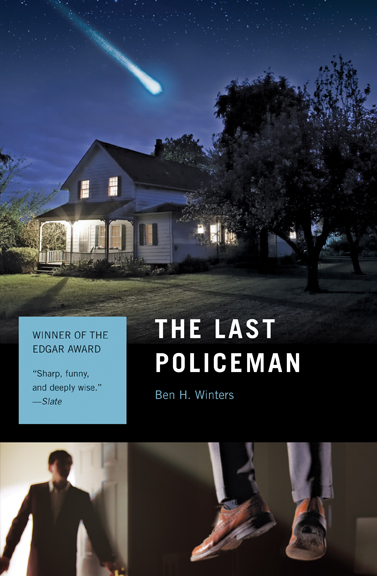
The Last Policeman by Ben H. Winters

I grabbed The Last Policeman after gleaning “New Hampshire rookie detective” from the summary I skimmed. Imagine my surprise when I found I’d purchased science fiction. Science fiction is my third-rail genre, y’all. The Last Policeman’s premise is not so much apocalyptic as pre-apocalyptic. An asteroid is on a direct flight to collide with and destroy Earth in six months – how, then, does one spend the time on the countdown clock? Personally, I’d have some sort of epic French-onion-dip consumption plan, but main character Detective Hank Palace is a better person than I am. Trying to live out his lifelong dream of being a professional policeman in an increasingly chaotic world, Palace is nobly fighting an uphill battle. Winters poses intriguing (and uncomfortable) questions about how much our humanity is tied to infrastructure and technology. Does Hank Palace’s loyalty to an old-fashioned sense of personal honor have a place in a society no longer constrained by any fear of accountability? I loved that push and pull in this book. The Last Policeman is the first book in a trilogy, and I’ve read the second one, Countdown City, and I’ve got the third one, World Of Trouble, on deck, so yes-I am reading science fiction now, apparently. (I assume the series stopped at three because that asteroid finally lands). Final score: Science Fiction 3, Bookreasons 1.

#edgarawards

Action Items
The 2016 Edgar Awards were presented in April. Check out that list, along with prior year winners and nominees, at http://www.theedgars.com/index.html