The Reason I’m Sleepy

A couple of nights back, I had a dream about Thornton Wilder. (NO, you pervert. It was not an erotic dream. It was a respectful dream. Literarily respectful). This was a first for me. Not just dreaming about Thornton Wilder, but dreaming about any author. My dreams are generally unremarkable-the usual fare entailing talking animals, having the ability to fly, or showing up naked for a math test. I’m nothing if not Freud’s most boring case study. (Sometimes, a math test is just a math test.) As much time as I spend reading, you’d think my dream life would be heavily populated with literature, but it’s not. It’s perhaps notable that I don’t dream about books, but I’ve never expected have dreams about authors. You know what would be amazing? Character dreams. For instance, could Jay Gatsby please show up in a dream and make out with me? Yes, he could. JAY: THE DOOR IS OPEN. Instead, Thornton Wilder showed up and hung around while I ran around doing dream stuff.

For those of you who have not been visited recently by Dream Thornton Wilder, let me catch you up. Son of the Midwest and global citizen, Thornton Wilder (1897-1975) had a gift for taking appallingly complex philosophical, moral, and historical topics and presenting them in works both approachable and relatable. A novelist and a dramatist, he is probably most known today for the play Our Town, the deceptively simple story of the citizens of Grover’s Corners, New Hampshire. Our Town scored the Pulitzer Prize for Drama in 1938. In his spare, non-Pulitzer-winning time, Wilder wrote novels, and his 1927 book The Bridge Of San Luis Rey won the Pulitzer Prize for the Novel. OOOPS. I made a mistake there. I meant in YOUR spare non-Pulitzer-winning time. Then, because everyone needs a hobby and his two other Pulitzers were lonely, Wilder picked up a third one in 1942 for the play The Skin Of Our Teeth. All of which leads me to wonder if Thornton Wilder ever dreamed about showing up naked for the Pulitzer Prize ceremony.

It’s sad, but even three Pulitzer prizes cannot keep an author on the top of the best-seller lists indefinitely. Now is a good time to confess that the only Thornton Wilder I have ever read is Our Town, and I have not read it in a long, long loooong time. However, since Our Town has ascended to Required Reading immortality, it feels like I read it every other year when I was in school. I’ve also seen it produced a few times. (Because the set for the play is a minimalist masterpiece consisting of a ladder and a couple of side chairs, Our Town is incredibly cheap to stage, meaning you can probably go see it at a high school near you right now.) Our Town tells the story of the intertwined lives of the Gibbs and Webb families in tiny Grover’s Corners, New Hampshire. The geography is interesting but ultimately irrelevant-Grover’s Corners could be any small town in any part of rural America in the years between the World Wars. In the traditional arc of events in a traditional life-graduations, marriage, parenthood-Wilder examines our relationship with our mortality and what is means to be resilient, not just in the face of personal tragedy, but in finding the strength to thrive in the banality of everyday life. It’s heady stuff, but Thornton Wilder sneaks past everyone’s Serious Drama Alarm System with the folksy, wry Stage Manager character. The Stage Manager guides the audience through the play, observing and commenting on the unfolding events in Grover’s Corners. He serves as the viewer’s advocate and representative on stage, right in the middle of that small town action. It’s a devastatingly effective way to involve an audience, and no matter how many times I have seen Our Town, it never fails to move me.

Our Town is a breezy read, and I really liked it every time I read it, but it hadn’t crossed my mind in a long time. I don’t even own a copy, which I discovered the morning after the Ghost of Thornton Wilder Past crashed my dream. I was a little embarrassed, and I hoped that Thornton Wilder would not show up again so I wouldn’t have to explain to him that he’d visited someone who didn’t even own ONE of his THREE Pulitzer Prize-winning works. (Seriously, y’all, Thornton Wilder will take every opportunity to bring up those Pulitzers. BRAGGY.) Off I went to the bookstore to remedy this glaring oversight. After hunting all over, I finally had to ask for assistance. A quick online search revealed that the only Thornton Wilder inventory in the store was one copy of Our Town in the Required Reading section.  It would seem that Thornton Wilder has fallen somewhat out of fashion. Clearly, the time is ripe for a whole Our Town branding reboot. Why not? Jane Austen’s well-manned Georgia era young ladies now genteely kill zombies. Abraham Lincoln is ridding frontier America of a vampire scourge. Isn’t it time for the citizens of Grover’s Corners to operate a training academy for international spies? Maybe it can be the location of a secret laboratory for the CDC where they research and cure all the urgent diseases and train international medical spies? Or perhaps the whole town collectively owns a maple syrup factory, which serves as a front for a safe house for international spies. I think you see where I am going with this.
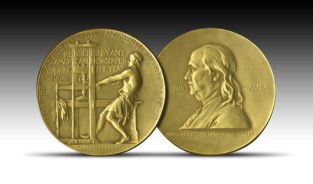
pulizter

Picked up some souvenirs from the Columbia University bookstore.

I’m not sure what possessed Dream Thornton Wilder to show up in my head, but clearly, he was slumming. If he’s looking to stage a comeback, he is doing it all wrong. I mean, I appreciate the consideration, but this Tiny Book Blog isn’t exactly going to deliver a splashy re-entry. I know he’s dead, but I think even dead Thornton Wilder could score a seat on James Corden’s couch or the cover of People magazine.

#comebackdreams

Action Items
Thornton Wilder wrote the screenplay for one of the best Alfred Hitchcock movies, Shadow of a Doubt. Netflix and chill with that.

The Reason I Have Solutions

If you’re in a frantic race to the finish full of stress and endless errands-congratulations! You’re doing the holidays right! It’s important to take shortcuts whenever you can, so hear me out when I tell you that:

  1. If you have an entertaining dilemma, Julia Reed probably has a solution, and
  2. Don’t bother doing stuff like taking pictures or making any kind of written record of your memories. TIME SUCK.

Click here and out how you can do the above simultaneously!

Boom

Who knows? Maybe a Julia Reed book is that perfect gift for someone on your list, in which case I’ve just solved THREE problems for you. YOU ARE WELCOME.

#gettingitdone

Action Items
Take a nap, probably.

The Reason It’s Trivial

The following is a true story.

When I was but a fledgling reader, the one of the first book series I devoured was that classic of American classics, Laura Ingalls Wilder’s Little House On The Prairie. The books appealed to me because they were entertaining and pleasant, accessible because book Laura was about my age, but still alien because of the historical frontier setting. Laura was frustrated with her siblings, just like me! So relatable! She uses an outhouse, while I have modern plumbing! So exotic! Laura’s adventures in pioneering were engrossing but benign..until book four. Nothing in my short life had prepared me for the bombshell waiting in By The Shores Of Silver Lake.

As By The Shores Of Silver Lake begins,  the entire Ingalls family is recovering from scarlet fever. Times were hard on the prairie! So exotic!  Everyone miraculously survives, which isn’t how things typically went down in a pre-modern medicine world, but Laura’s older sister Mary is rendered blind by the disease. LIKE SHE JUST WAKES UP BLIND WTF. I was stunned. It wasn’t that I didn’t know that blindness existed. I just didn’t know that someone could just UP AND GO BLIND. WHY HADN’T ANYONE TOLD ME PEOPLE COULD JUST UP AND GO BLIND? Mary, of course, rallies to her circumstances, gathers her resources, and perseveres with the support of her loving family. Her inspiring example made me panic. I knew if I JUST UP AND WENT BLIND I would crumple like a piece of old tin foil. Even at a young age, I recognized my lack of internal fortitude. In my panic, I began to practice being blind so that if scarlet fever ever found me in the suburbs, I would be prepared. I ate with my eyes closed. I got dressed with my eyes closed. As it turns out, I was terrible at doing those things with my eyes closed, but one thing I got really good at was taking a shower in the dark. It took a while, but I got to the point that I could shower in the dark more efficiently than with the bathroom lights on. I practiced it so often that to this day, I shower in the dark. It just feels more natural. COME AT ME. PRAIRIE DISEASES. I AM READY.

True stories are sweepingly epic, or horrifying, or chilling, or heartbreakingly sad. (Or really dumb. See paragraphs 1-2.) Resultingly, true stories are great foundations for books, but a true story isn’t a guarantee of a great book. In the right hands, a well-told true story makes a book an equivalent of a phenomenal TED Talk-compelling and informative. In the wrong hands, you end up with a book equivalent of a toaster cooking demonstration-unnecessary and boring. What about a true story really matters? Does a story rivet a reader with insight, or stop a narrative in its tracks with irrelevance? These are the questions that authors struggle with. Unless, of course, the author is historian David McCullough.

David McCullough has told some of the most fascinating true American stories there are to be told. He’s been blowing the doors off American social history since his first book, The Johnstown Flood, was published in 1968. McCullough’s painstaking research marries with his lively storytelling style to make a convivial learning experience. He’s everyone’s favorite history teacher. His presidential biographies are enough to justify his formidable reputation (John Adams, Truman, Mornings On Horseback) but McCullough also tells larger stories about the unique experiences that contribute to the American identity. From the history of the Brooklyn Bridge to the year 1776 to American aviation, McCullough will entertain you and turn you into an armchair historian all in one book. You know where armchair historians are in demand? TRIVIA NIGHT. That’s right: David McCullough will make you smarter and more popular.

For maximum American history trivia answers packed into one true story, it’s hard to do better than McCullough’s The Greater Journey: Americans In Paris. America in the 1830s was a country on the move, busy building on the potential and the promises of the successful Revolution. A new generation took on the task of forging what it meant to be American by engaging in the time-honored practice of traveling abroad. In particular, Americans headed to Paris to take up residence, steep themselves in culture, and study and practice in their chosen fields. The result was an America that developed upon a foundation of New World democracy and Old World intellectual tradition. A thorough education was one that embraced the value of broadened horizons, so it was not unusual to spend multiple years in Paris before sailing back across the pond. Because David McCullough wants your team to win every single American history category including the double points round, this book delivers reams of trivia about notable Americans like Elizabeth Blackwell, James Fenimore Cooper,  and Oliver Wendell Holmes.

Of all the true stories that David McCullough tells in The Greater Journey, my favorite is that of Samuel Morse. Prior to The Greater Journey, the only thing I knew about Samuel Morse is that he invented the telegraph and Morse code and the only reason I knew that is because I read a million scrappy kid detective stories in which the scrappy kid detective, tied up and thrown into a closet/attic/cellar by the bad guy, gets rescued by tapping out a message in Morse code. As it turns out, before he invented the telegraph and detective rescue Morse code, Samuel Morse was a portrait painter. He went to Paris to improve his painting skills, and while there he spent hours every day at the Louvre, immersing himself in as much art as he could cram into his eyeballs. He distilled his time there in one of his most famous works, The Gallery At The Louvre, 38 of the Louvre’s most famous paintings rendered in miniature.  For Americans who did not have the means to experience the greater journey, Morse’s painting – and subsequently, Morse’s communication invention – closed unimaginable distances. If you can’t parlay all that Morse knowledge into a seat at the team trivia table, then you’re just not trying hard enough.

gallery_of_the_louvre_1831-33_samuel_morse

1830s Snapchat

Recently, some scrappy medical detectives published a paper recapping 10 years of research into Mary’s blindness. It turns out Laura’s true story about scarlet fever isn’t actually true, and the likely disease culprit is not scarlet fever but viral meningoencephalitis. The end result is the same: someone can up and go blind, so I’m still showering in the dark. It’s probably time to learn Morse code, too. Just in case.

#TeamMcCullough

Action Items
Medical detectives are awesome.  

Image of The Gallery of the Louvre 1831–33 is in the public domain {{PD-US}}

The Reason To Pick Up A Spare

Peoplewatching is the best. I love being in the vicinity of a crowd. Plant me in a corner seat in a bar, an out-of-the-way chair at an airport, the back row at a wedding, and I am set. Watching interpersonal intersections is endlessly fascinating. The best peoplewatching, though, is when I score an invite to a family reunion for a family other than my own. Family reunion dynamics are flat out epic. It’s like watching bowling. People mill about in tightly formed clusters, maintaining uprightness, then BAM! Someone knocks everyone nine-eyed by telling the story of how Aunt Helen and Aunt Kathy got into a shouting match at Bobby’s wedding over who was sitting at the better table.
Bobby: It was Helen
Me: Don’t start
Bobby: She bribed me with a better gift
Me: You’re making it worse

Come to think of it, the entire family reunion experience is like a day at the bowling alley. It’s loud, you probably won’t like the music, and somewhere, someone is definitely keeping score. The best strategy to employ is to find your team, name it something silly, and keep your head down bowling your frames until it’s last call. If that’s even beyond you, though, stay home and read a book about someone else’s family dynamic, and make sure that book is Commonwealth, by Ann Patchett.
Bobby: I named my team
Me: I’m listening
Bobby: Best Seats In The House
Me: Way to poke the bear

Ann Patchett is a bestselling author, gifted writer, and owner of one of America’s most amazing bookstores because life isn’t fair. Well—it’s fair to HER. Not to me. I have to make special trips to bookstores because I don’t own my own, and when I do get to the bookstore, none of my bestselling books are on the shelf. Ann Patchett has to skirt around the giant Personally Written Bestsellers Section of her own bookstore just to get to her cash register so she can check out the next person in line there to buy one of her books. Commonwealth is her latest novel, a story of how families are made and unmade, of the collective territory of shared experience, and of how memories can tether us to each other even when we’ve left the past behind. It’s a wholly beautiful book, and Ann Patchett is astonishing in her ability to move the narration seamlessly from the past to present to the past. She understands that the key characteristic of family dynamics is baggage.
Bobby: Like a bowling bag
Me: Nope
Bobby: I keep bowling shoes in mine
Me: You own your own bowling shoes?
Bobby: Nope

An uninvited stranger’s attendance at an overdue christening party is all it takes to circumvent the seemingly settled lives of two families. Bert, an indifferent husband and a casual father to three-and-one-on-the-way, manufactures countless reasons to avoid participating in his home life. He wanted lots of kids, it’s just that actually parenting lots of tiny humans is, you know, a bummer. It’s in this spirit that Bert crashes a christening party for a co-worker’s new baby rather than spend a weekend afternoon with his own children. Several gin and juices and one kiss later, Bert has met the woman who will eventually be his second wife, and Commonwealth gets down to the messy business of affairs, divorces, and remarriages.

When all the dust Bert kicks up settles, there are six children in a new blended family that none of them asked for and none of them want. Anyone who grew up in a large family will recognize themselves somewhere in these brothers and sisters. Age, birth order, gender—all those slippery quantifiables that determine what your power is and where you can wield it. As the kids in Commonwealth grow up and make peace with the choices their parents have made, Patchett presents each of their stories in turn. The sibling relationships in this book are front and center, and what makes this book so powerful is Patchett’s ability to give each character’s perspective equal weight while maintaining the flow and the momentum of the story.

One of the universal experiences of childhood is grappling with powerlessness by declaring “When I grow up, I’m never going to do anything I don’t want to do” while one of the universal truths of adulthood is grappling with the discovery that we very often have to do things we don’t want to do. If attending family functions during the holidays is one of the things that you don’t want to do, the characters in Commonwealth are right there with you. Feeling stuck in an old family dynamic gets, well, old. What are the compromises we have to make as grownups to participate in family narratives that are sometimes older than we are?

bowling

If you find yourself stuck at a family gathering, and things are starting to get ugly, book a few lanes at the nearest bowling alley. Keep Aunt Helen and Aunt Kathy on separate teams at opposite ends. Bobby likes to stir things up, so keep him in the middle and give him the team with all the kids to keep him busy. Grab a lane yourself and knock some pins down. Or, if bowling isn’t really your thing, grab a seat where you can see everyone and settle in. The peoplewatching is great at a bowling alley.

#strike

Action Items
If you are close to Nashville, immediately visit Parnassus, Ann Patchett’s bookstore.

The Reason To Walk The Line

One of the fundamental expectations I have of the books I read is that in any given book, STUFF WILL HAPPEN. The plot, characters, story arc, theme, point-of-view….basic book guts should be present, accounted for, and delivering. Honestly, if I wanted nothing to happen in what I read, I’d stick to technical manuals and pre-screened credit offers. Having said that, I do have a threshold for the quality and amount of stuff that happens in a book. There’s a tipping point for when a story can feel overwrought and overdone. Simply put, there’s a fine line between dramatic and drama. Please allow me to illustrate:

The Cubs win their first World Series in 108 years in extra innings in a rain-delayed final game of the series? Dramatic.
People starting fistfights over discount sheets at Target on Black Friday? Drama.
Awaiting the first photographs of Jupiter from the Mission Juno spacecraft? Dramatic.
Any episode of any reality show that includes “big”, “fat” and/or “war” in the title? Drama.

Dramatic story elements are like cake. You can flavor them however you want, layer them for gravitas, and even carve them into weird shapes. Drama is the icing, piped on in swooshy swirls and decorated with sprinkles for flair and impact. Just enough of each makes you crave dessert, but too much and you’re looking at diabetes. Today’s roundup offers up some books that dance along that fine line and deliver a little of both.

Forward: A Memoir (Abby Wambach) Abby Wambach made soccer history repeatedly during her run as a power forward with US Women’s Soccer. Most goals scored in World Cup play? Check. 100 career goals scored? Check. World record for most goals scored (breaking Mia Hamm’s world record, NBD)? Check. Abby Wambach retired as a soccer player in 2015 with 184 career goals in international play, more than any player has ever scored-male or female. Her memoir begins and ends with soccer, laying out her tortured relationship with her body and how she translated that into the mind-blowing, powerful playing style that captured America’s attention. In her private life, Wambach grappled with revealing her sexuality to her family and her public, addictions to pills and alcohol, and a rocky marriage. Now sober and working for ESPN as an analyst and a contributor, Wambach’s memoir is less a reflection on a past long gone than a laying out of her strategy for tackling her demons in her future.
The Fine Line:
Dramatic After spending her post-high school graduation summer skipping workouts, drinking all the beer, and inhaling all the junk food, Wambach showed up for her first workout as a Florida Gator completely unprepared and out of shape. Knowing her spot on the team was on the line, she forces herself to get through drills so punishing that they made me nauseous just reading about them.
Drama Blow-by-blow, word-for-word recreations of looooong text exchanges with friends during personal crises.

Breakfast At Tiffany’s (Truman Capote) If you are only familiar with the movie version of Truman Capote’s novella, then what you’ve seen is a sanitized version of this story, cleaned up for a conventional 1950s audience. The book is infinitely more twisted. On the page, Truman Capote lets his bitch flag fly, and Truman Capote has a Ph.D. in Bitch Flag. Holly Golightly is an opportunistic country girl come to town, looking to make her fortune as someone’s wealthy wife in postwar NYC. Her story is told by her brownstone neighbor and friend, a man who at first observes Holly’s comings and goings and then becomes part of her inner circle. The first person narration puts us uncomfortably close as Holly jumps from various frying pans into various fires. For all her self-destructive faults, Holly possesses a shrewd charm that is just as compelling today as it was when this work was first published. All of Truman Capote’s contradictory longings for fame, social cachet, and privacy are manifested in this jewel box of a book.
The Fine Line:
Dramatic Holly’s touching, pure love for her brother Fred. He is never far from her thoughts and his well-being is her motivation as she looks for financial security.
Drama Holly forces her pet cat out onto the streets of New York to fend for itself because she and her cat are independent souls who “never made each other any promises.”

The Queen Of The Night (Alexander Chee) Generally speaking, you can’t get more dramatic than opera. Opera is the loaded double burger with cheese and bacon on the drama menu. The Queen Of The Night is an opera in novel form, with Alexander Chee delivering a life story so fantastic it’s just this shy of magical realism. Set in Paris during the Second Empire, under the reign of the Emperor Napoleon III and Empress Eugenie, The Queen Of The Night is a master class in social climbing, and falling, and climbing again. Our heroine, Lilliet Berne, is the toast of Paris, enjoying success and fame as a leading soprano. When she is offered the opportunity to realize every singer’s dream of originating a role in an opera written especially to showcase her talent, she agrees to meet with the composer to discuss the possibility. It is then that she discovers the novel on which the opera is to be based is actually her own life story. Lilliet’s quest to find out who spilled her secrets takes the reader through Lilliet’s very eventful life. There is just a whole lot of book going on here, and Chee ingeniously enfolds the tradition and elemental structure of opera into the story. I could not put this book down, but damn, it wore me out.
The Fine Line:
Dramatic Lillet’s childhood on a farm in Minnesota comes to an abrupt end when she is orphaned as a fever wipes out her family.
Drama Prussian soldiers invade Paris and Lillet escapes capture in a hot-air balloon.

Southern Living White Cake, Red Velvet, Peppermint, White Chocolate, Coconut

Burp.

Ultimately, drama tolerance is relative. Your mileage may vary, but there’s an immense literary satisfaction in indulging in juicy, well-executed drama. It’s the holiday season -indulge! Put on your biggest sunglasses, fling that long scarf back over your shoulder, toss your hair, and dive in. Act like you own the place.  It worked for Holly Golightly.

#fineline

Action Item
Maybe get a giant hat too. And a hot-air balloon. Just in case.

The Reason To Get Into The Groove

Once, I was invited to a really big birthday party. I’ll pause while you shake your head in disbelief, but hey, on occasion I slip past the deflector shields and make it onto a guest list. It was a big crowd, a surprise party, and I didn’t know most of the people there. I arrived alone and a little early (NERD ALERT), and the people that I did know that were attending hadn’t gotten there yet. So, rather than stare at the wall or eat all the tiny stuffed peppers out of anxious boredom, I struck up a conversation with a guy standing near me who also seemed a bit at loose ends (but it’s possible he was just eyeing the peppers too). After a quick exchange confirming exactly when we were supposed to yell ‘SURPRISE’ at the guest of honor, he started telling me how he spent his day, which had been a glorious stretch of hours during which he’d put some new parts on his motorcycle. He was really excited. He pulled out some pictures. Several pictures, in fact, of the bike before he’d put the new parts on, pictures of the parts themselves, and pictures of the bike after the parts had been added. As he warmed to his topic, he described the motorcycle parts in detail and why they mattered so much to his overall motorcycle experience. I tried to ask meaningful questions about what he was sharing, but my motorcycle knowledge is limited to the words “motorcycle” and “crotch rocket”, so I didn’t have much to contribute. Seventeen minutes after I’d started talking to this person, he didn’t know my name, but I knew every detail about his motorcycle transformation arc. Also, by this point, most of the tiny stuffed peppers were gone because the other people at the party knew a good appetizer when they saw it. We finally wrapped it up when we had to hide, a critical step in staging a surprise.

While it’s true that I don’t speak motorcycle, I didn’t need to in order to see that my party partner was sharing his passion. Everyone has their own thing, a thing that makes us so excited and eager that people will run if they see you getting fired up about it. Nobody in their right mind will talk to me about books, for instance. I’ve never gone as far as pulling out pictures of books when I talk about them but I’m not saying that won’t ever happen. (Unrelated note: follow Bookreasons on Instagram to see some dreamy pictures of books!) It’s one thing to verbally firehose everyone in your immediate vicinity with all of the ways you enjoy your favorite thing. It’s another thing entirely to make it a condition of any human interaction. There’s a thin line between enthusiasm and obsession, but you’d never prove that by the immersive Ready Player One, by Ernest Cline.

Ready Player One is Ernest Cline’s love letter to 80s geek and pop culture. Wait-strike that. Ready Player One is Ernest Cline’s ticker tape parade celebrating 80s geek and pop culture, complete with Tshirt guns and confetti cannons. Set in a grim future on an overpopulated Earth depleted of natural resources, Ready Player One tells the story of a society that has moved from the exterior to the interior. Virtual reality is the standard, with people spending as much time as possible strapped into full body suits logged into in a fantasy universe called OASIS. When the reclusive inventor of OASIS, James Halliday, dies and invites the whole world to compete to inherit his fortune in an elaborate 80s themed video game, the stage is set for some awesome 80s-style scrappy-underdogs-vs-evil-corporate-goliath competition.

You don’t have to be an 80s kid to enjoy this story. Ernest Cline has you covered even if you didn’t spend part of your childhood begging for an ATARI console or getting chased by PacMan ghosts. James Halliday is modeled on America’s Silicon Valley trajectory, a gifted programmer parlaying time spent tinkering with computers in his parents’ basement into a wildly successful industry and stratospheric personal wealth. In the three dimesional world, James is shy and awkward, finding interpersonal interaction painful. Inventing OASIS allows him to make his perfect reality over and over, as he programs planet after planet that recreate the late 70s and and 80s that he grew up in (my personal favorite being an entire planet consisting of video game arcade/pizza joints, and I want to go there because I hate waiting in line to play Tempest). Retreating into OASIS solves all of James’s social problems, but in his isolation, he’s unable to do the one thing that makes a personal passion so fun – share it with people that share his same devotions.  Upon his death, he’s finally able to get everyone to come to his playground. What would any of us do if we had the leverage to create the exact world we want, to engage with people in the way that makes us the most comfortable? James Halliday uses his money and influence to share everything he loves on the grandest scale possible.

Ready Player One is currently being turned into a movie by Steven Spielberg. I don’t usually get excited about movie versions of books I love, but OMG. I need Steven Spielberg to direct this 80s themed movie like I need air and regularly scheduled hair color appointments. I NEED it. I need all those 80s references filtered through the guy that gave us so much 80s culture. Interestingly, Steven Speilberg has said in interviews that he will not be referencing his own movies in Ready Player One. I don’t like telling Steven Spielberg how to do his job but he needs to change his mind on that. STAT. He’s going to leave Indiana Jones at the door? The Goonies? Whaaaat?

I suppose while I’m quibbling with Steven Spielberg on his directorial choices, I may as air my one tiny grievance with Ernest Cline. In the avalanche of dazzling 80s references in Ready Player One, there is not one appearance by the Material Girl. No Madonna. At all. I am calling a flag on that play and in the sequel I’d better see a Planet Madonna.

corman_8_watermark_madonna

Represent.

#livinginamaterialworld

Action Items
My personal Thanksgiving tradition is to re-read MFK Fisher’s The Gastronomical Me. I hope you get to enjoy your traditions this year. Have a safe & happy Thanksgiving Day!

Photo credit: Richard Corman for Rock Paper Photo

The Reason To Put Me In, Coach

A couple of weeks ago, my friend, blogger and writer Baddest Mother Ever, invited me to attend a very cool book tour event with her.  I was  immediately in because “book” and then “TOUR” so YUP.  Lucky for me, it was Luvvie Ajayi’s book tour in support of her first book, I’m Judging You: The Do-Better Manual. We were going to get to meet Luvvie in a pre-event reception, hug her neck in a photo op, and get our books signed. I was thrilled because one of my favorite kind of books is Autographed Books. (Other favorite kinds of books include Book I Am Reading Right Now and The Next Book I Am Going To  Read.) I also detected an ulterior motive in the invitation, in that Baddest Mother Ever has been complaining that her TBR list is too long because every time she reads my blog, she adds another book to her list. Since she’d already read I’m Judging You, she was heading off my next book recommendation at the pass and neutralizing the Bookreasons impact to her list. I SEE YOU, BADDEST.

I could not wait to read I’m Judging You: The Do-Better Manual and meet Luvvie Ajayi, because I am always looking for new, highly qualified life coaches. I need an army of life coaches. It’s because in my head, I operate with sophistication and grace. I’m manners personified and I know exactly how to react in any situation because of my inherent maturity and genteel upbringing. In my head, I’m Jacqueline Kennedy. On the outside, I’m also Jacqueline Kennedy, assuming Jacqueline Kennedy swore like a drunken sailor, had a laugh loud enough to peel paint, and had the personality that is commonly associated with the first, cranky stage of a hangover. I try to have couth, I really do, but I am just naturally couth-repellent. I’m often told that I’m the “mean friend who’s really nice!” Ooops. Whenever I hear that, I cringe and put another notch in my “Failed At Keeping My Mouth Shut” belt. It’s got a loooot of notches.  The only way I can justify my blundering style is to say that when you interact with me, you’re getting unintentional authenticity. You’re also getting a lot of F-bombs, but you should probably have expected that authenticity comes with F-bombs, so that’s on you. Basically, in most social situations, I’m Godzilla, and the world is my Tokyo.
Godzilla: (Stomps on Tokyo)
Tokyo: Ouch
Godzilla: Sorry
Godzilla:(Stomps on Tokyo)
Tokyo: Ouch
Godzilla: Sorry
Godzilla: (Stomps on Tokyo)
Tokyo: FFS GODZILLA

Luvvie Ajayi is an authentic truth-teller too, but considering that she’s built a successful career from authentic truthtelling, I was hoping I could learn from her how to be less Godzilla and more like one of those Disney ballet hippos from Fantasia. Luvvie is a blogger, pop culture commentator, activist, and digital strategist who has made a name for herself on the Interwebz with her savvy, forthright commentary on everything from Game of Thrones to race relations to technology. She’s channeled her insight and humor into her first book, I’m Judging You: The Do-Better Manual.  I’m Judging You is a collection of humorous essays explaining exactly what we’re all doing wrong and how she’s judging us for it.  She’s knowledgeable, experienced, frank, and funny, and her book is so entertaining and illuminating I barely noticed it was slapping me upside the head with solid life coaching.

Baddest and I arrived at the venue, got our books, and found the lounge where the meet and greet was transpiring. After meeting Luvvie, engaging in some low-key fangirling, AND GETTING MY BOOK AUTOGRAPHED YES THANK YOU, we took our seats for the main event of the evening: an interview with Luvvie conducted by author Denene Millner. All the salient questions were covered: Luvvie’s background, the germination of the idea for her book, her writing process, and how her life has changed since her book was published. I was especially interested to hear how she has personally driven her own book tour after receiving the minimal amount of support from her publisher. From an initial two city tour to seventeen stops-and counting-Luvvie used the power of her network to drive potential readers to her book, landing I’m Judging You on the New York Times bestseller list. It’s the kind of change that social media is driving, a circumvention of the usual routes by which a book does or does not succeed.

When the interview concluded, Luvvie took questions from the audience. It’s worth mentioning that this event was sold out with a 200 person waiting list. Luvvie has been a presence on the Internet since 2007, when we used stone tablets and chisels to enter logon IDs. As a result, her fanbase is deep. It wasn’t surprising to see that she had a full house there to support her first book. What was remarkable, though, was the thread that tied together the questions that the audience asked. One by one, the people chosen to ask a stood, took the microphone and initiated their question by telling Luvvie when they first found her. “I’ve been following you since 2007.” “My friend told me about you and I’ve been reading your newsletter for years.” “I was one of your first followers on Facebook.” “I saw a keynote address you did a few years ago and I’ve been a fan ever since.” Some people told intensely personal stories about struggle, and hardship, and how much it meant to have Luvvie’s words as a touchstone. Most everyone talked about the importance of the laughter and pure entertainment that they found in their Luvvie corner. I’m Judging You is a first book and will be the first time many people read Luvvie Ajayi. But to the community of fans that grew up reading Luvvie, it’s the next stage in an ongoing conversation they’ve been having for years.
Godzilla: I like autographed books too
Tokyo: You don’t say
Godzilla: (stomps on Tokyo)
Tokyo: Godzilla can you stand still for like five damn minutes

While making me delicate or refined is probably beyond even Luvvie’s powers of transformation, watching the members of Luvvie Nation reaffirmed for me why I love the written word so much. Words help us connect, and the digital age, for all of its flaws, has amplified the potential and the power of that connection. Luvvie Ajayi is currently taking the power of that potential on a book tour. Thanks for inviting me, Baddest. I liked being Luvviejudged. And – your break is over. Next week, I’m going to recommend some James Joyce.

ajayi

Sign here please

#godzillastompstokyo

Action Items
Immediately upon finishing I’m Judging You, I washed all my bras. You’ll understand after you read the book.

The Reason For A Lot Of Reasons

Bookreasons launched one year ago. I’m a little shocked. I didn’t think I had three months worth of book-babbling opinions, much less a whole year, but here we are. Thanks for indulging me. As it turns out, I’m just a fountain of ever-flowing book babble. Who knew?
You: Everyone
Me: No way! I’m not that obvious
You: Look! A book!
Me: WHERE I’VE READ IT IT’S GREAT LET’S DISCUSS IT
You: The prosecution rests

Today I am throwing back to one of the first Bookreasons posts about one of my all-time favorites, A Wrinkle In Time. You can click here to read it. Madeline L’Engle had a lot to say about tolerance and fear. This book is now getting the film it deserves from the amazing director Ana DuVernay.

menzies

Teaser.

#happybookaversarytome

Action Items
Read all about the A Wrinkle In Time production here.

The Reason It’s Not In Order

There is an intended compulsivity to my To-Be-Read list. Theoretically, I read what’s on my stack in the order in which it was added to the stack. My books should all wait their turn behind the velvet line divider next to the sign that says “Wait Here For Next Available Associate”. It’s a neat, orderly procession because I don’t like my books to crowd me and line management is important. In theory, everything executes like clockwork, one of those Swiss clocks that is a marvel of efficiency and accuracy.

In practice, my To-Be-Read list is less a line of well-behaved books patiently waiting their turn than a crowd rushing the entrance of Toys”R”Us the day after Thanksgiving. There’s pushing, shoving, hair-pulling, and at least one fistfight. I want to be methodical and deliberate, I really do, because from the outside that approach seems marvelously productive. It’s a practice I have yet to translate into reality. For example, I’ve had Stacy Schiff’s The Witches on my list since the day it came out. That book is a straight-up diva though and I haven’t had the necessary uninterrupted time that a diva demands. Then there are my disappeared titles, because I lost my working TBR list in a disastrous iPhone update a few months ago so there are a bunch of books that I know I want to read but no longer know the names of. WHYYYY APPLE WHYYYY??? Then, of course, there are the books that are recommended to me by other enthusiastic readers. I get super pumped for those because sharing is caring and asking me to read a book you like is a secret mystery-coded message that says you like me BEST of all the people you know. It’s ok! I won’t tell anyone else that I am your favorite. If all of this feels like an elaborate justification as to why I just had to bump Mary Shelley’s Frankenstein to the top of the stack last week, well, your instincts are dead on.
Me: HAHAHAHAHA
Mary Shelley: Whut
Me: DEAD on. Get it??
Mary Shelley: Ugh

I suppose if any book is going to push to the front of the line with terrible manners and superhuman strength, it would be Frankenstein. The story behind the book is almost as famous as the book itself. In 1816, Mary Shelley and her husband the poet Percy Shelley were on an extended European tour, staying away from England for really good reasons that included avoiding Percy’s first wife Harriet, who was a tad cranky because Percy had run away with Mary while still married to Harriet. While in Switzerland, Mary, Percy, Mary’s stepsister Jane and their friends Lord Byron and John Polidori found themselves stuck inside on a rainy day. They challenged each other to tell ghost stories to pass the time and that was one hell of a one-up story session because that little party germinated both the vampire genre (hat tip to John Polidori) and the Frankenstein monster.
Percy: Whatcha doing Mary
Mary: BRB writing classic horror novel
Percy: Well “classic” might be premature—
Mary: also inventing science fiction
Percy: Okay, sure, it’s original but-
Mary: what’d YOU do today
Percy: whatever

I hadn’t read Frankenstein in a long loooong time and in truth, I didn’t read it that closely the first time. It was assigned reading in a British Literature class, a class in which the volume of assigned reading was honestly insane. The teacher’s approach was basically “British people wrote a lot of stuff. Let’s read all of it in two months.” It was all I could do to keep up with it. By the time that class was over, I was so burned out I hated England, Princess Diana, tea, Masterpiece Theater, and Monty Python. As a result of this shallow immersion, most of the Frankenstein lore I was carrying around in my head was supplied by Mel Brooks. (I’m not even sorry because Gene Wilder’s hair in “Young Frankenstein” is perfection.) When a friend told me she was reading Frankenstein for her book club and struggling a bit with it, I couldn’t abandon her to the wilds of English gothic horror. I had been there, and I have the scars to prove it. It was time to up-end my TBR stack yet again, stop skating on my sketchy, force-fed-British-Lit Frankenstein memories, and give that tall drink of mostly dead water the attention it deserved.

One trip to the used bookstore later, I was prepared to be scared. The Frankenstein monster we know, the force of nature that is a dangerous combination of brute power and pure instinct, is a creepy figure, but the Frankenstein monster in the book is actually far removed from today’s pop culture, neck bolt version. The monster’s creator, Victor Frankenstein, is an arrogant scientist who single-mindedly pursues the ultimate scientific challenge – creating life in inanimate tissue. Once he reaches his goal, he abandons his creation, unable to come to terms with the ramifications of his actions and unwilling to accept responsibility for his profound discovery. Mary Shelley curses her monster with self-awareness, a being who is unable to feel gratitude for the life he was given because he knows he is ultimately not of the world that he’s living in. This book is wildly modern, and the questions Mary Shelley raises about the ethical pursuit of knowledge are even more relevant now. I was also stunned at what a huge whiny man-baby Victor Frankenstein is. I missed that completely the first time around. I was rooting for the monster, frankly.
Mary: Me too TBH
Me: Right??

the-inheritance

Stackus Interruptus.

My TBR stack is still a work in progress, a messy monster of my own creation. After I finished Frankenstein, I went back to the next book in the stack and promised myself no more interruptions. I’d completely forgotten that Charles Finch’s new one in the Charles Lenox series, The Inheritance, came out this week. Ooops. Charles Lenox has VIP status at my club so he always goes to the front of the line. I’ll get back to the stack right after I finish it.

#frontoftheline

Action Items
You might be able to catch the National Theater Live’s version of Frankenstein. It’s making encore rounds now. Check it out here.

The Reason To Go All In

A few weeks back, I posted a detailed cry for help in which I described how distinguished author Ben H. Winters was holding me hostage. (You can read about Ben H. Winters’ indifference to my plight here.)As a result of my signal flare, a friend crawled into my foxhole with me and picked Underground Airlines for her book club read. When I asked her what she thought of the book, she 1.heroically ignored my clapping and bouncing up and down when I asked the question because I could not WAIT to effuse about the book with someone and 2. Said she really liked it but was a bit ticked because she does not usually read trilogies. Confused, I pointed out Underground Airlines is a standalone book. She responded “Are you kidding? That is the first book in a trilogy if I ever saw one. Like we are NOT going to get the next part of that story?”

Well, hell. Upon reflection, Underground Airlines could be the first in a trilogy. For the record, I asked the internet if there are any follow-up books forthcoming. The internet said “What the hell? This book was only published in JULY. Slow your roll.” Okay, internet, CHILL, it was just a question. It’s interesting, though, that instinctive phobic reaction so many people seem to have about trilogies. I don’t have any science on this or anything. It’s just based on my experience recommending books to people only to be asked “Is that book in a trilogy? I don’t do trilogies.” It is a delicate and serious thing to open one book knowing that you are in essence opening three. It takes your book status from “in a relationship” to “it’s complicated” to “what am I, getting married here?” at warp speed.

If you are trilogy-shy, I am here to support you by cramming a trilogy recommendation into your reluctant hands. Don’t think of it as a trilogy! Think of it as…a house party where you get to hang out with some jacked up, compelling people. Think of it as a three-day weekend in an exotic place you’ve never been. Think of it as a blind date set up by someone you really, really trust and who would NEVER stick you with the book equivalent of Jon Gosselin. Think of it as your chance to find some brand new literary crushes.  Do not deny yourself the pleasure of Lyndsay Faye’s brothers Wilde, Valentine and Timothy, the heart and heartbeat of the Gods of Gotham trilogy.

The Gods of Gotham, Seven for a Secret, and The Fatal Flame tell the story of the founding of New York City’s modern Police Department, a story that Lyndsay Faye is uniquely qualified to tell. Her first book, Dust and Shadow: An Account of the Ripper Killings, is a Sherlock Holmes story narrated by John Watson. (It is a standalone book, YES, if I can’t talk  you into a trilogy.) That Sherlockian momentum that encompasses a diverse, lively setting, organic, intricate plots and memorable characters carries forward into the Gods of Gotham. If you read this trilogy for no other reason, do it to cast the movies in your head, because the Wilde brothers and all the New York citizens that surround them are going to get under your skin. Lyndsay Faye is a genius at characterization and she gives her characters a solid, startling setting in which to do their thing. New York City in 1845 was multiple worlds existing in parallel: Tammany Hall and tenement immigrants, abolitionists and brothel owners, the desperately poor working class and the newly wealthy industrial barons. When those streams cross, all kinds of stuff is liable to happen. Right about now, you’re expecting me to break down each of the books with a little high-level summary. TWIST! I am not going to do that. What I am going to do is tell you about MAH BOYZ.


trilogy

Don’t think of it as a trilogy. Think of it as three books tied together by common characters, story arc, and setting.


Timothy and Valentine Wilde are themselves the embodiment of 1845 New York City. Valentine Wilde is the older brother and the political animal, an enthusiastic member of the party machine and a powerful local celebrity. Valentine doesn’t see corruption – he sees opportunity. He sees favors granted, favors denied or favors wrangled. He delights in the maneuvering and the gladhandling that was necessary to rise in the party ranks. I am in awe of Valentine. He’s scary smart and subversive and sort of amoral. Also, his name is Valentine. He gives me the vapors. If I had gone to high school with Valentine Wilde, I would have spent endless hours figuring out how to get him to notice me. MORE EYELINER? BIGGER HAIR? TELL ME.

My breathless crush on Valentine in no way decreases my mellower-but-still intense crush on the younger brother and main character of the trilogy, Timothy Wilde. Timothy is an idealist, disgusted by the push-or-be-pushed vibe that defines almost every interaction in New York. Where Valentine Wilde is the sweeping energy and breakneck pace of the city, Timothy Wilde is its humanity. He’s noble, he’s stubborn, and he’s the perfect candidate for a position with the brand new Police Department: politically protected by his influential brother but himself disinterested in politics, he just wants to solve some crime and make things a little safer for people who otherwise can’t fend for themselves. Throw in his unrequited love for the beautiful and unattainable Mercy Underhill and omg I have the vapors AGAIN. OVER HERE, TIMOTHY. I’M VERY SENSITIVE. I’LL HOLD YOUR HAND AND WALK ON THE BEACH IN THE RAIN.

Come for the characters, stay for the plots, move in for the fun. Jump in! The water’s fine! However much you enjoy them, though–remember, the Wilde brothers are mine. I’ll share, but if you try to take my men, someone better hold my earrings because we are going to throw down.

#getWilde

Action Items
The regular publishing day for Bookreasons is moving from Tuesdays to Wednesdays.If you would like to get email notifications of new posts, please click on the ‘Follow’ button in the lower right-hand corner of your screen, enter your email address, and click on the link in the verification email.

If you already subscribe, thank you! I will forever be grateful (and baffled) for your willingness to endure my nonsense.